AHPRA-Compliant Meta Ads for Cosmetic Clinics: What Still Works
Meta Ads for Australian cosmetic clinics sit under Ahpra’s advertising rules and Meta’s own ad review. Here is what still works, with compliant ad copy templates.
 Vikas Thakur Founder, Perth Updated Jun 14, 2026 9 min read Fact checked
Key takeaways
- Testimonials are prohibited in advertising a regulated health service, including higher risk non-surgical cosmetic procedures such as injectables and dental veneers
- Before/after images are not banned outright under Ahpra’s Guidelines for advertising higher risk non-surgical cosmetic procedures (date of issue 2 September 2025), but the conditions are strict: genuine patients, no editing, a prominent warning, and the after image never the most prominent
- Meta Ads face two separate compliance layers: Ahpra’s advertising rules AND Meta’s own ad review
- If the procedure involves a prescription-only medicine, Ahpra says the TGA requirements apply as well
- Educational content works within the rules, as long as it informs rather than entertains
- This post does not quote CPM, CTR or booking-rate benchmarks, because we have no sourced Meta Ads data to publish
Patient testimonials and before/after photos are the two creative formats Ahpra’s cosmetic procedure guidelines address directly.
Testimonials are off the table. Before/after images are still possible, but only if every condition in Ahpra’s cosmetic procedure guidelines is met, and the safest route is to leave them out of paid ads altogether (our view, not an Ahpra requirement).
Ahpra’s guidelines say that content on public and private social media profiles or groups may constitute advertising under the National Law if the content relates to a regulated health service. A Facebook ad is advertising. An Instagram story is advertising. A boosted post is advertising.
The question that follows: what is left?
More than you might think. Meta Ads still work for cosmetic clinics when the creative and copy strategy shifts from social proof to education and intent.
The Two Compliance Layers for Cosmetic Clinic Meta Ads
Running Meta Ads as an Australian cosmetic clinic means working within two separate rule sets that do not always align.
Layer 1: Ahpra advertising rules
These apply to advertising of regulated health services. The cosmetic procedure guidelines state that they apply to registered health practitioners, individuals who are not registered health practitioners, and businesses, partnerships and corporate entities. Under the advertising guidelines, advertising must not:
- Use testimonials or purported testimonials about the service or business
- Be false, misleading or deceptive
- Offer a gift, discount or other inducement unless the terms and conditions of the offer are also stated
- Create an unreasonable expectation of beneficial treatment
- Make claims about providing a superior regulated health service
For higher risk cosmetic procedures, the cosmetic procedure guidelines add specific rules on images, testimonials, titles and qualification claims, and price lists. They say that price lists for procedures involving a prescription-only medicine, such as cosmetic injectables, must comply with the TGA requirements. Check the TGA’s guidance before you name a product or publish a price for an injectable treatment.
Layer 2: Meta’s ad review
Meta applies its own ad standards regardless of Ahpra. We could not open Meta’s policy pages to quote them for this update, so this post does not summarise them. Read Meta’s current advertising standards for health and wellbeing and for personal attributes before you build an audience or write copy. Content that Ahpra allows may still be rejected by Meta, and an ad that Meta approves can still breach the National Law. Meta approval is not a compliance check.
What Is Still Allowed in Cosmetic Clinic Meta Ads
Treatment education
General educational content about treatment categories is, in our view, the lowest-risk base. Explain what a treatment category involves, who it may suit, and what a consultation covers, without promising outcomes or comparing yourself to other practitioners.
Illustration of descriptive wording (our example, not wording Ahpra has approved): “Wrinkle relaxer treatments are available at our clinic. Our practitioners consult with each patient individually to discuss suitability.”
Avoid: naming a prescription-only product (check the TGA requirements first), showing a patient result without meeting every image condition, or implying your practitioner achieves better outcomes than others. Ahpra lists claims about providing a superior regulated health service as a breach.
Clinic and team content
Content about your clinic environment, your practitioner credentials, and the consultation experience avoids patient imagery entirely. Practitioner credentials need care: Ahpra’s cosmetic guidelines have a section on titles and claims about training, qualifications, registration, experience and competence, so state only what the practitioner’s registration supports.
Allowed: clinic photography (rooms, equipment, consultation setting), team introductions, clinic values and approach to patient care.
Avoid: content that implies the practitioner achieves outcomes others cannot.
Consultation booking focus
Ads that focus on the consultation process itself, rather than treatment outcomes, are, in our view, a lower-risk format than outcome-led ads. One catch: if you offer a free or discounted consultation, the advertisement must also state the terms and conditions of the offer.
Educational video
Short educational video explaining what a treatment category does, what the consultation involves, and what questions patients commonly ask needs no patient imagery. Ahpra asks that imagery in higher risk cosmetic advertising be used responsibly, for the purposes of information and/or education only. The same guidelines give examples of content more likely to be seen as entertainment that trivialises these procedures: music, dancing, singing or comedic comments, and montages not directed at presenting information. Keep Reels informative and plain.
We have not published performance data comparing educational video with before/after creative, so we do not claim one outperforms the other.
If You Still Want to Use Before/After Images
Ahpra’s cosmetic procedure guidelines set out the requirements for before and after images. In summary, they say:
- Both images must be genuine, meaning actual patients who had the advertised procedure performed by that health practitioner
- The first or most prominent image must be the before image or a combined image, because an after image shown most prominently may create unrealistic expectations
- The images must be as similar as possible in lighting, camera angle, background, framing, exposure, posture, clothing and makeup
- Images must not be edited or enhanced, for example with filters or retouching
- The after image should say how long after the procedure it was taken
- Images intended to show outcomes must include a prominent warning that the outcomes are relevant only to that patient
- Images of people under 18 must not be used
The same page also says testimonials must not be used, and that a testimonial can include linking to images showing outcomes of a procedure in some circumstances. Read that section in full before you reuse patient content. When in doubt, leave patient imagery out of paid social.
Compliant Ad Copy Templates
These templates focus on the consultation rather than the outcome, and on the treatment category rather than specific products. They are starting points, not legal advice. Check each one against the Ahpra pages linked above before you publish.
Template 1: Consultation booking (low commitment)
Considering [treatment category]? Our practitioners consult with each patient
individually. No pressure, just honest advice about whether a treatment is
right for you.

[Book a consultation: link]
If the consultation is free or discounted, add the offer’s terms and conditions to the ad.
Template 2: Educational lead (awareness stage)
Not sure which [treatment area] treatment is right for you?
Our consultation covers your concerns, your treatment options,
and what realistic outcomes look like for your specific situation.

[Book a consultation: link]
Template 3: Clinic credibility (trust building)
[Practitioner name and registered title]. [Registered profession and years in practice].
We take the time to explain your options and tell you when a treatment
is not suitable. Honest advice matters more than volume.

[Learn about our approach: link]
Template 4: FAQ format (educational)
"What is the difference between [treatment category A] and [treatment category B]?"

This is a common question in consultations.
The answer depends on [relevant factor]. [Brief 2-3 sentence educational response].

[Read the full guide: link to blog post]
Targeting
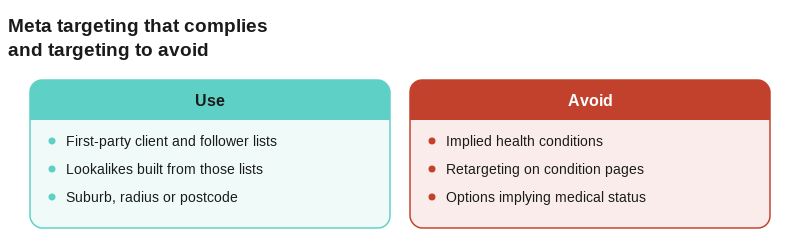
Build audiences from your own first-party data where you can: your client list, your Instagram followers and your website visitors, then expand with lookalike audiences. Use broad location targeting (suburb, city radius or postcode) for a local clinic.
Be careful with anything that implies knowledge of a person’s health condition or appearance. Confirm the current rules on Meta’s own site before you use health-related interests or retarget visitors of condition-specific pages.
A clinic’s real costs vary by suburb, treatment, creative and landing page, so use your own Ads Manager data rather than a benchmark. Treat Meta as a way to introduce your clinic to people who are not yet searching, with Google Ads for people who already are. That split is our view of how the two platforms work, not a measured result.
The Landing Page Compliance Problem
An ad can be compliant and still send traffic to a landing page that carries the old content.
Ahpra’s guidelines apply to advertising in any form, including all electronic media that promotes a particular provider of cosmetic procedures. That includes your website. A compliant ad that sends traffic to a page with patient testimonials is still a breach.
Checklist for a compliant cosmetic clinic landing page:
- No patient testimonials, including star ratings and reviews you publish or quote
- Any before/after images meet every condition listed above, or are removed
- No claims of superiority (“Perth’s leading cosmetic clinic”)
- Prices for procedures involving prescription-only medicines follow the TGA requirements
- Offers state their terms and conditions
- Treatment descriptions focus on the category and the consultation, not the outcome
What to Do with Your Existing Creative Library
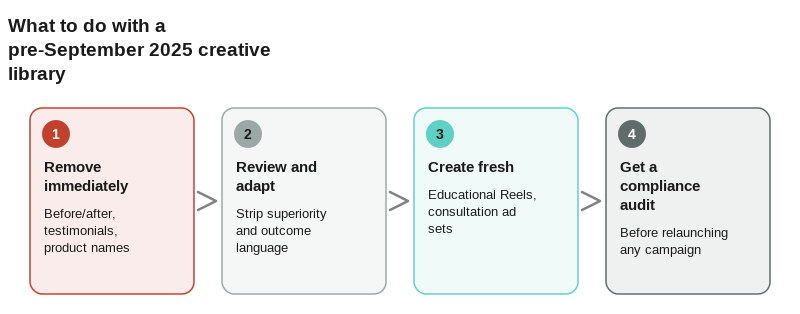
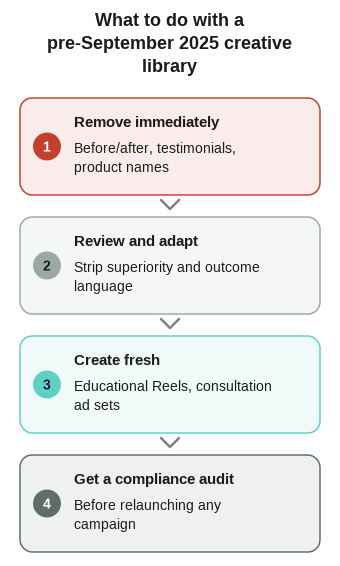
If you built your Meta Ads creative library before Ahpra’s cosmetic procedure guidelines were issued on 2 September 2025, some of it is likely non-compliant. Here is the practical approach:
Remove immediately: All video or image testimonials. All patient imagery you cannot show meets the before/after conditions. All superiority claims.
Review and adapt: General clinic content, practitioner introductions, educational explanations of treatment categories. Remove any language implying superiority or guaranteed outcomes, and check product names and prices against the TGA requirements.
Create fresh: Educational Reels in the format described above. Consultation booking ad sets using the templates above. FAQ-format content covering the questions patients ask in consultations.
Get it fixed: Before relaunching any campaigns, bring your ad account, creative library, website and landing pages into line with the current Ahpra guidelines. Book a call and we will do it with you.
Need a Compliant Meta Ads Strategy for Your Clinic?
ClinicCode runs AHPRA-compliant Meta Ads for Australian cosmetic clinics. We rework your current advertising across all channels so it is compliant before anything else runs.
Call me back to have your Meta Ads account, Google Ads account, website, and landing pages fixed.
Vikas Thakur
Founder, Perth. 16 years of experience from working at TPG, iiNet and Monadelphous, now helping Australian clinics keep their websites, ads and online presence AHPRA compliant.