TGA Says a Clinic Booking Widget May Count as Advertising
TGA guidance from June 2026 says a public booking system can count as advertising prescription medicines. The cases the TGA published in 2026 were about importing unapproved products, so this post separates what the guidance says from what the cases show.
 Vikas Thakur Founder, Perth 9 min read Fact checked
Key takeaways
- On 18 June 2026 the TGA published guidance on advertising restrictions for prescription medicines. Its release says the guidance covers websites, social media, business names and logos, booking systems, product catalogues and price information
- The guidance says a publicly available booking system that details the availability of specific prescription medicines at a health service “may amount to advertising of those medicines”
- It treats indirect references as covered. An example it gives is “wrinkle reduction injections” as a substitute term
- The 2026 infringement notices the TGA has published for cosmetic injectables concern alleged importation of unapproved products, not booking widgets
- The TGA lists infringement notices, directions, prevention notices and civil or criminal proceedings as possible responses
If your booking system lists prescription medicines by name as treatments and encourages bookings for them, the TGA’s own example calls that prohibited advertising. If it uses a substitute term, the guidance says an indirect reference is likely to be read as a reference to a prescription medicine when viewed in context.
This guide covers what the TGA’s guidance says, what its 2026 enforcement releases actually involved, and what to check on your own booking system.
What the TGA Guidance Says About Booking Systems
Under the Therapeutic Goods Act 1989, advertising prescription medicines to the public is prohibited, except under very limited circumstances. That is the TGA’s statement in its media release of 18 June 2026. The release says the new guidance explains the advertising and promotional activities likely to be prohibited across websites and social media, or in business names and logos, booking systems, product catalogues, price information and other materials.
The guidance itself, Complying with the restrictions on advertising prescription medicines to the public, makes three points that matter for a clinic website.
- Booking systems. A publicly available booking system or product catalogue that details the availability of specific prescription medicines at a health service may amount to advertising of those medicines.
- Indirect references. An indirect reference is likely to be considered a reference to a prescription medicine when viewed in context, even if no specific product or substance is named. The guidance’s table of substitute terms includes “Wrinkle reduction injections” and “Weight-loss injections”, and colloquial names such as “Tox”.
- Price information. Listing prices for treatments that involve or reference prescription medicines is generally likely to amount to advertising of those medicines.
Source: TGA, media release and guidance, seen 25 November 2026.
The guidance gives a worked example. A cosmetic clinic lists “wrinkle-reduction services” on its booking system, lists prescription medicines by name as treatments, and encourages customers to book for those treatments. The TGA says that promotes the use of prescription medicines and is prohibited advertising.
Takeaway: The TGA assesses what the booking page communicates. In our view, the safest reading is that the booking flow needs the same review as the ad copy.
What the 2026 TGA Cases Actually Involved
The TGA’s 2026 releases on cosmetic injectables are about importation. They are not about booking widgets. The TGA’s 6 July 2026 release on a New South Wales nurse says it issued 3 infringement notices totalling $11,880 for the alleged unlawful importation of unapproved cosmetic injectables. The nurse allegedly imported unapproved vials of botulinum toxin and pre-filled syringes containing lidocaine. The notices were issued in May 2026.
Other 2026 releases follow the same pattern. The chart below shows the total value of notices in each release. Each release covers one or more people, so the bars are not per-person fines. All matters are alleged.
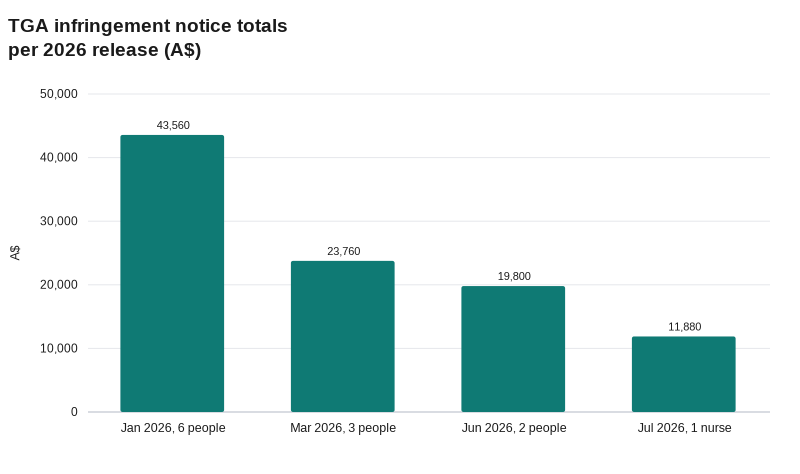
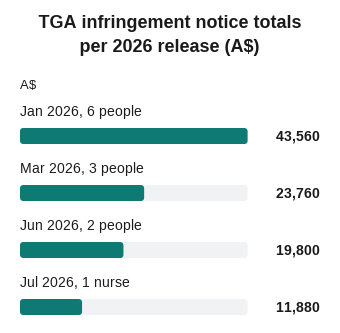
Source: TGA media releases of 29 January 2026 (11 notices totalling $43,560), 26 March 2026 (6 notices totalling $23,760), 17 June 2026 (5 notices totalling $19,800) and 6 July 2026 (3 notices totalling $11,880), seen 25 November 2026. Australia-wide, in Australian dollars.
The January release also says a NSW-based individual allegedly unlawfully advertised botulinum toxin products on a social media platform. That is the only advertising allegation in the four releases above.
An earlier release, from 18 December 2023, reported 4 infringement notices totalling $13,656 to 2 registered nurses. A Victorian-based nurse received 2 notices totalling $6,600 for allegedly importing unapproved botulinum toxin type A and pre-filled syringes. A Queensland-based nurse received 2 notices totalling $7,056 for allegedly importing unapproved botulinum toxin type A and advertising prescription-only medicines on social media. The release says the products are not on the Australian Register of Therapeutic Goods (ARTG). It also says references to prescription-only medicines, “either overt or by implication, through abbreviations or the use of colloquialisms”, are unlawful.
Takeaway: None of these releases says a booking widget was the basis for a notice. The booking-system point comes from the June 2026 guidance, not from the cases.
How the Penalties Compare
The TGA says penalties for breaches of the Act include civil penalties of up to $1.65 million per breach for individuals or $16.5 million per breach for corporations, as well as fines or imprisonment. It lists infringement notices, directions, prevention notices and civil or criminal proceedings as the actions it may take.
Ahpra’s penalties are separate. Under its advertising and the law page, a court may order a maximum of $60,000 per offence for an individual and $120,000 per offence for a body corporate. Ahpra’s advertising guidelines page still carries footnote 3, which gives Western Australia maxima of $30,000 for an individual and $60,000 for a body corporate against the unlawful use of a protected title offence, and the page does not reconcile it with its statement that the higher penalties apply in all jurisdictions, including Western Australia, as of July 2024.
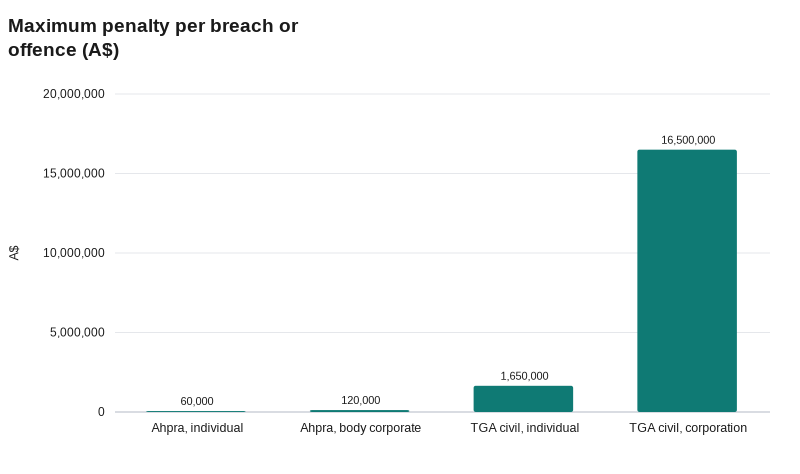
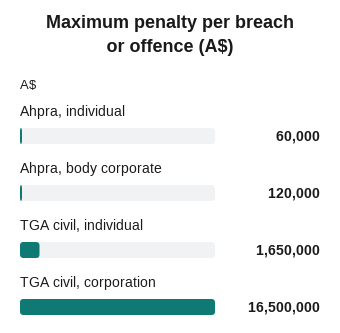
Source: Ahpra, Advertising and the law and TGA media release, 18 June 2026, seen 25 November 2026. The two regulators apply different laws, so the bars show each regulator’s stated maximum, not a like-for-like comparison.
What to Check on Your Own Booking System
These checks come from the TGA’s guidance. Treat them as a prompt for a regulatory review, not as legal advice.
- Does your booking widget list a prescription medicine by name, abbreviation or nickname? The guidance lists names, abbreviations and colloquial names as references.
- Does it use a substitute term for a class of prescription medicines? The guidance lists “Wrinkle reduction injections” and “Weight-loss injections” among its examples.
- Does your booking flow let a visitor browse or search medicines for a condition, or show price information for them? The guidance gives both as examples that may amount to advertising.
- Do your before and after photos suggest the result came from a prescription medicine? The guidance says before and after photos are not prohibited by the Act, but expressly or implicitly suggesting the after photo is due to a prescription medicine is likely to be advertising.
Takeaway: In our view, the booking widget is a compliance checkpoint to review alongside your treatment pages.
FAQ
What did the TGA’s new advertising guidance say about booking systems?
The TGA published guidance on 18 June 2026 saying that a publicly available booking system or product catalogue that details the availability of specific prescription medicines at a health service “may amount to advertising of those medicines”. It also lists indirect references and substitute terms, such as “wrinkle reduction injections”, as likely to be treated as references to a prescription medicine when viewed in context.
Does a “Book Now” button on my clinic website count as prescription-medicine advertising?
Not by itself. The TGA’s guidance is about what the booking system says. If it lists prescription medicines by name or by substitute term as treatments and encourages bookings for them, the TGA’s own example calls that prohibited advertising. A general appointment button that does not refer to a prescription medicine is a different matter. Ask a regulatory adviser about your own flow.
How much can the TGA fine a clinic for this?
The TGA says penalties for breaches of the Therapeutic Goods Act 1989 include civil penalties of up to $1.65 million per breach for individuals or $16.5 million per breach for corporations, as well as fines or imprisonment. The infringement notices in its 2026 releases are a lower step that the TGA lists alongside directions, prevention notices and civil or criminal proceedings. Ahpra’s advertising penalties are separate: up to $60,000 per offence for an individual and $120,000 per offence for a body corporate. Ahpra’s advertising guidelines page still carries footnote 3, which gives Western Australia maxima of $30,000 for an individual and $60,000 for a body corporate against the unlawful use of a protected title offence, and the page does not reconcile it with its statement that the higher penalties apply in all jurisdictions, including Western Australia, as of July 2024.
How do I check if my booking system and website copy are compliant?
Read the TGA’s guidance, Complying with the restrictions on advertising prescription medicines to the public, and compare each treatment name, price line and booking option against its examples. In our view, a clinic should have a regulatory adviser review any borderline wording before it goes live.
Get Your AHPRA and TGA Compliance Checked
ClinicCode fixes cosmetic clinic websites, booking flows, and ad accounts against current AHPRA and TGA advertising rules.
Sources and References
TGA - TGA releases new guidance on advertising restrictions for prescription medicines, 18 June 2026
TGA - Complying with the restrictions on advertising prescription medicines to the public (published 18 June 2026, last updated 23 June 2026)
TGA - Infringement notices to a nurse for alleged unlawful importation of cosmetic injectables, 6 July 2026
TGA - Infringement notices to 6 individuals, 29 January 2026
TGA - Infringement notices to 2 health practitioners and an individual, 26 March 2026
TGA - Infringement notices to a health professional and an individual, 17 June 2026
TGA - Two nurses fined for allegedly importing unapproved cosmetic injectables, 18 December 2023
Ahpra - Advertising and the law: penalty maxima
Ahpra - Advertising guidelines: footnote 3 and the July 2024 penalty note
Related reading:
- Meta’s New Ad Rules Won’t Save You From a $120K AHPRA Fine: the parallel gap between platform policy and regulator rules
- AHPRA Advertising Fines for Cosmetic Clinics: the full AHPRA penalty structure
- AHPRA Compliance Audit Checklist: a step-by-step self-audit guide
For booking systems and websites built compliant from the first draft, talk to us about your clinic’s marketing.
Vikas Thakur
Founder, Perth. 16 years of experience from working at TPG, iiNet and Monadelphous, now helping Australian clinics keep their websites, ads and online presence AHPRA compliant.