Ahpra Advertising Penalties: $60,000 and $120,000 Per Offence
Ahpra’s Advertising and the law page gives a maximum penalty of $60,000 per offence for an individual and $120,000 for a body corporate. Here is what section 133 covers and what the caps could add up to.
 Vikas Thakur Founder, Perth Updated Nov 23, 2026 8 min read Fact checked
Key takeaways
- Ahpra’s Advertising and the law page gives a maximum penalty of $60,000 per offence for an individual (for example a registered health practitioner) and $120,000 per offence for a body corporate
- Ahpra says that as of July 2024 these increased penalties apply in all jurisdictions, including Western Australia
- Section 133 of the National Law is the advertising offence. It covers false or misleading advertising, inducements, testimonials, unreasonable expectations of beneficial treatment and encouraging unnecessary use of health services
- Ahpra says a court may order a penalty “for each offence”. The page does not say how many offences one advertisement counts as, so any multiple in this post is our arithmetic, not an Ahpra figure
- For higher-risk cosmetic procedures, Ahpra says advertising must not use testimonials and that images must not be edited or enhanced
- If your clinic trades as a company, the body corporate cap is the one that applies to it
Ahpra’s Advertising and the law page sets out the penalties for advertising breaches of the Health Practitioner Regulation National Law. A court can impose a maximum of $60,000 per offence on an individual and $120,000 per offence on a body corporate. The same page says: “As of July 2024 these increased penalties now apply in all jurisdictions, including Western Australia.” Ahpra’s advertising guidelines page still carries footnote 3, which gives Western Australia maxima of $30,000 for an individual and $60,000 for a body corporate against the unlawful use of a protected title offence, and the page does not reconcile it with its statement that the higher penalties apply in all jurisdictions, including Western Australia, as of July 2024.
Those are maximums, and they attach to each offence. What the page does not say is how many offences a single advertisement counts as, or how a court would treat the same claim repeated across a Google ad, a landing page and social posts. That is a question for a lawyer, not a marketing agency. This post shows what the caps could add up to if each ad were charged separately, labels that clearly as our arithmetic, and sticks to what Ahpra says on the rest.
What Section 133 Actually Penalises
Ahpra’s page states that section 133 of the National Law says a person must not advertise a regulated health service in a way that:
- Is false, misleading or deceptive, or is likely to be
- Offers a gift, discount or other inducement to attract a person to use the service or business
- Uses testimonials or purported testimonials about the service or business
- Creates an unreasonable expectation of beneficial treatment
- Directly or indirectly encourages the indiscriminate or unnecessary use of regulated health services
Ahpra also says other consequences may apply when a registered health practitioner breaches the advertising requirements, and that a National Board may decide a breach raises a concern about the practitioner’s conduct.
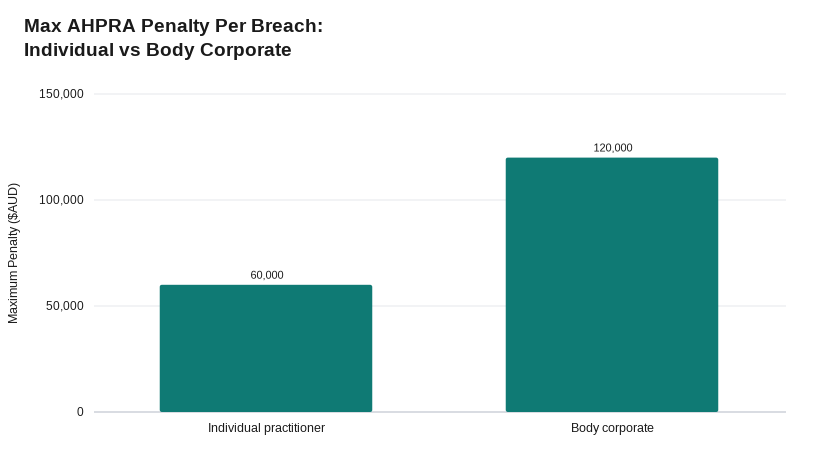
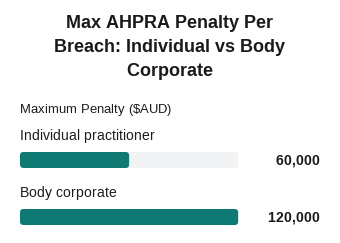
Source: Ahpra, Advertising and the law, seen 24 November 2026. Figures are the maximum penalty per offence in AUD: $60,000 for an individual, $120,000 for a body corporate.
Takeaway: The body corporate cap is exactly double the individual cap, so which entity runs the advertising matters.
What the Caps Could Add Up To
Ahpra’s page says a court may order a penalty “for each offence”. It does not say how many offences one advertisement counts as. If, purely for illustration, each separate piece of advertising were charged as its own offence at the maximum, the totals would be simple multiplication:
| Offences (illustration) | Individual cap x N | Body corporate cap x N |
|---|---|---|
| 1 | $60,000 | $120,000 |
| 3 | $180,000 | $360,000 |
| 5 | $300,000 | $600,000 |
| 10 | $600,000 | $1,200,000 |
Source: our arithmetic (N multiplied by the $60,000 and $120,000 maximums on Ahpra, Advertising and the law, seen 24 November 2026). Figures are AUD and are theoretical ceilings, not predicted or reported penalties. We have not found a published case that reached any of these totals.
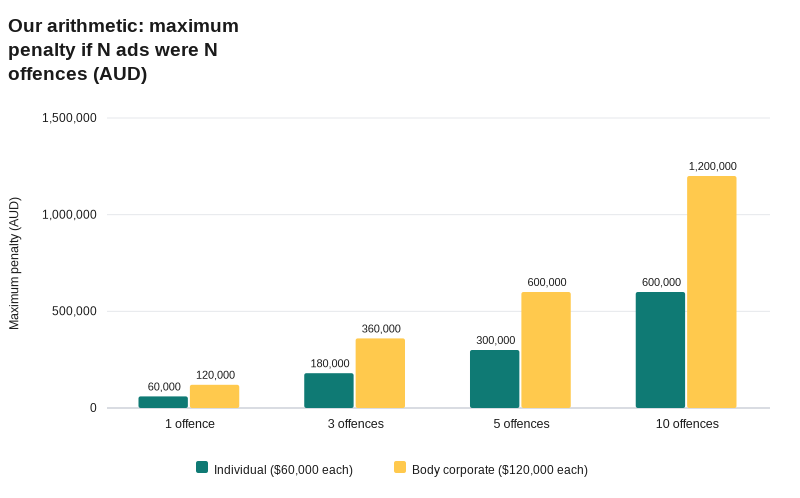
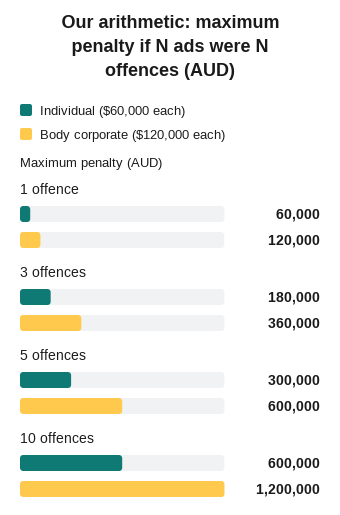
Source: our arithmetic from the per-offence maximums on Ahpra, Advertising and the law, seen 24 November 2026. AUD; theoretical ceilings assuming each ad is a separate offence, which Ahpra’s page does not state.
Takeaway: The headline cap is per offence, and Ahpra does not tell you how offences are counted. Treat the multiples as a reason to check every live ad, not as a forecast.
What Ahpra Says About Cosmetic Advertising
Ahpra’s advertising guidance for higher-risk cosmetic procedures says:
- “The National Law specifically prohibits the use of testimonials or purported testimonials” in advertising, and advertising of higher-risk cosmetic procedures must not use testimonials
- “Before and after” images may create unrealistic expectations, and images used in advertising of higher-risk cosmetic procedures must not be edited or enhanced
- Higher-risk procedures are non-surgical procedures undertaken to revise or change the appearance, with dental veneers, botulinum toxin and dermal fillers given as examples
- Advertising that involves a prescription-only medicine, such as cosmetic injectables, must also meet TGA requirements
Ahpra’s media release on the new cosmetic procedure guidelines says the guidelines for registered health practitioners who perform cosmetic procedures come into effect on 2 September 2025.
In our reading, section 133 describes the advertisement itself (for example, whether it uses a testimonial or is misleading). The wording quoted on Ahpra’s page does not make patient harm a condition of the offence. That is our reading of the text, not legal advice.
Urgency language such as “book before prices rise” and outcome promises such as “look 10 years younger” are, in our view, the kind of copy that can run into the inducement and unreasonable-expectation limbs of section 133. Ahpra’s page does not list those phrases, so check any such wording against the guidelines.
If your clinic’s Google Ads, landing pages or social content haven’t been checked against these rules since the cosmetic guidelines took effect, getting them reviewed is a sensible step before any notice arrives.
Takeaway: Testimonials and edited before/after images in higher-risk cosmetic advertising are named directly in Ahpra’s guidance, so they are the first things to look for.
Individual vs Body Corporate: Why It Matters for Clinic Structure
Ahpra’s page applies the $120,000 cap to a body corporate and the $60,000 cap to an individual such as a registered health practitioner. In our view, that means the entity that publishes the advertisement matters. A practitioner trading under their own ABN sits under the individual cap. If the advertisement is published by the clinic company, the body corporate cap is the one in play. We have not found Ahpra guidance on how a prosecutor chooses between the practitioner and the company for the same advertisement, so ask a health lawyer about your own structure.
ClinicCode’s compliance fix and build service for cosmetic clinics builds AHPRA-compliant advertising and websites into the process from the start rather than auditing them after the fact.
Takeaway: The advertising rules are the same for both. The maximum attached to getting them wrong is not.
How to Check Your Own Advertising
A practical audit, in our view, looks like this:
- Pull every live piece of advertising: Google Ads, Meta ads, the website, Google Business Profile, email
- Check each against the section 133 list above and Ahpra’s cosmetic advertising guidance: testimonials, before/after images for higher-risk procedures, inducements without terms, outcome claims
- Fix or remove anything that matches, and keep a dated record of the fix
- Rebuild pages that rely on that content (before/after galleries, patient quote sections) around compliant alternatives
The fourth step is where an audit can stall. A landing page built around before/after photography and patient testimonials needs replacing with something that still works, not just deleting. ClinicCode designs AHPRA-compliant cosmetic clinic websites around that constraint from the first wireframe.
Takeaway: An audit that only removes non-compliant content trades one problem for another, a page that no longer does its job.
The Source Pages
Screenshots of the pages cited in this post, taken on 24 November 2026 and framed on the passage each one supports.
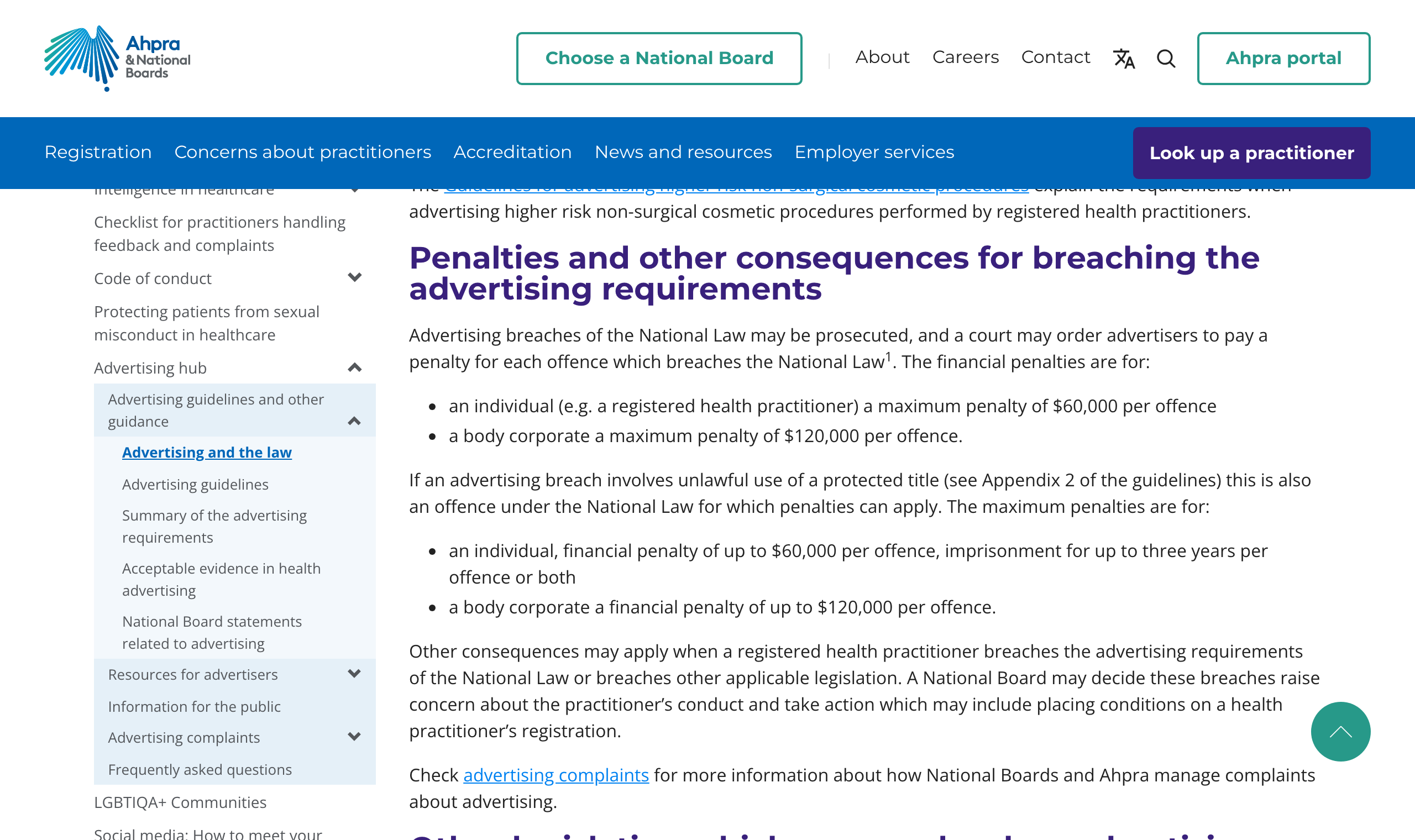
Source: Ahpra, Advertising and the law, screenshot taken 24 November 2026.
The Bottom Line
Ahpra’s page gives $60,000 per offence for an individual and $120,000 per offence for a body corporate, and says the higher penalties apply in every jurisdiction, including Western Australia. How many offences a set of ads would count as is not stated, so the larger totals above are our arithmetic only.
ClinicCode builds and fixes websites for Australian cosmetic clinics against these rules. If your advertising has not been updated since the cosmetic guidelines took effect, book a call.
Data sources: Ahpra, Advertising and the law; Ahpra, advertising higher-risk non-surgical cosmetic procedures; Ahpra, new cosmetic procedure guidelines media release, 3 June 2025. All seen 24 November 2026.
Related reading: for the broader AHPRA advertising framework, see Ahpra Advertising Complaints 2025/26 and the Penalty Caps.
Vikas Thakur
Founder, Perth. 16 years of experience from working at TPG, iiNet and Monadelphous, now helping Australian clinics keep their websites, ads and online presence AHPRA compliant.