GLP-1 Sales Up 8.6x in Australia: Surgery Demand [2026]
Australian GLP-1 monthly sales rose from 57,941 to 496,875 units between May 2020 and April 2025, 8.6 times on our arithmetic. What the figures show, what no Australian source has measured, and what US and ISAPS data say about body-contouring demand.
 Vikas Thakur Founder, Perth 8 min read Fact checked

Key takeaways
- Monthly sales of GLP-1 medications in Australia rose from 57,941 units in May 2020 to 496,875 units in April 2025, which a UNSW-led report that has not been peer reviewed calls “almost 10-fold” (8.6 times, our arithmetic from the two figures)
- Nearly 500,000 Australians, almost 2% of the adult population, use GLP-1 medicines every month, according to UNSW
- Of the more than 6 million units dispensed through April 2025, 47.8 per cent were accessed privately, according to a summary of the same UNSW study
- In the US, an ASPS report found 20% of GLP-1 patients under the care of ASPS member surgeons had already had plastic surgery, 39% were considering surgery and 41% a non-surgical procedure
- The ISAPS 2024 survey lists 10,395 liposuction and 9,975 abdominoplasty procedures for Australia. Neither source links these to GLP-1 use
- No Australian source we could find measures how much cosmetic surgery demand GLP-1 use has created
What this data is, and what it is not
This post pulls together four separate sources. None of them measures what clinic owners most want to know: how many extra Australian body-contouring enquiries come from people on GLP-1 drugs.
- Drug sales (Australia): a UNSW-led report by Michael Falster and colleagues, covering sales and PBS dispensing from May 2020 to April 2025.
- Surgeon survey (US): the American Society of Plastic Surgeons (ASPS) 2024 statistics release. It counts US patients of ASPS member surgeons, not Australians.
- Procedure counts (Australia): the ISAPS 2024 International Survey. It reports procedure totals by country. It does not record whether a patient was on a GLP-1 drug.
- Complication study (US): a retrospective study of 373 panniculectomy patients, reported in Plastic and Reconstructive Surgery.
Put side by side, they describe a fast-growing group of people losing weight, a body-contouring market already doing real volume, and a gap where the link between the two should be.
GLP-1 sales in Australia, 2020 to 2025
GLP-1 receptor agonists include semaglutide (sold as Ozempic and Wegovy) and tirzepatide (sold as Mounjaro). Falster’s team compared sales to pharmacies with Pharmaceutical Benefits Scheme (PBS) dispensings from May 2020 to April 2025.
SBS News reports the result this way: “Sales of GLP-1 medications have increased almost 10-fold from 57,941 units in May 2020 to 496,875 units in April 2025.” SBS also notes the report has not been peer reviewed and that the figures are likely an underestimate. Dividing the two unit figures gives 8.6 times (496,875 / 57,941), which is why our title says 8.6x rather than repeating “almost 10-fold”.
| Measure | Figure | Source |
|---|---|---|
| Monthly GLP-1 units sold, May 2020 | 57,941 | SBS News |
| Monthly GLP-1 units sold, April 2025 | 496,875 | SBS News |
| Australians using GLP-1 medicines each month | Nearly 500,000, almost 2% of adults | UNSW |
| Share of units accessed privately | 47.8% of more than 6 million units dispensed through April 2025 | BioPharmaDispatch, quoting the UNSW study |
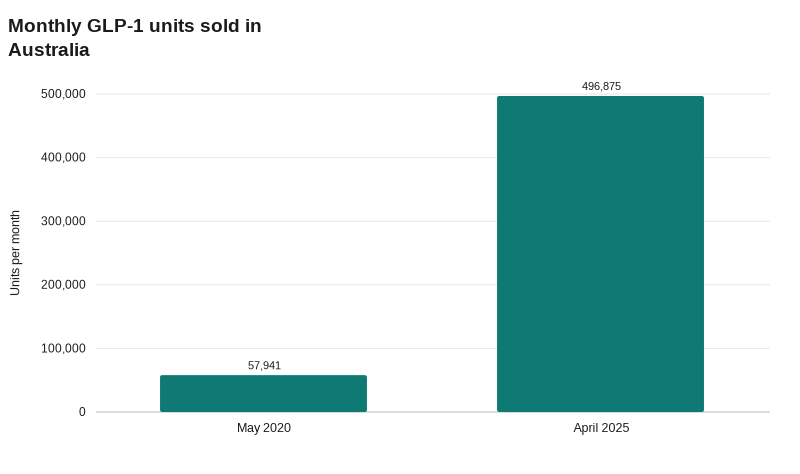
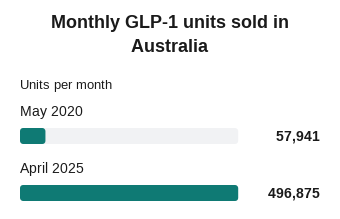
Source: SBS News, “The Ozempic-sized force turbocharging an Aussie food shake-up”, reporting the UNSW-led study.
The chart shows sales of units, not patients. One person can account for several units a month, so sales growth is not the same as growth in the number of users. The UNSW figure of nearly 500,000 users is a separate estimate.
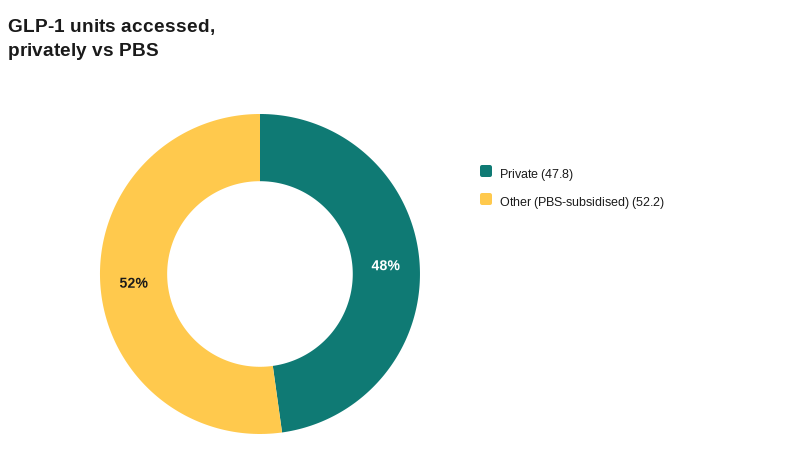
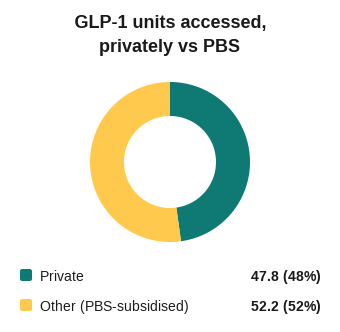
Source: BioPharmaDispatch, quoting the UNSW study. The 52.2% slice is our arithmetic (100 minus 47.8), and it assumes everything not accessed privately was PBS-subsidised.
The chart shows that close to half of the units in the study period were bought without a PBS subsidy. We did not find an official Australian figure for what patients paid per month, so this post does not quote one.
What US surgeons report about GLP-1 patients
Large, fast weight loss can leave loose skin that diet and exercise do not tighten. That is the clinical reason surgeons expect more body-contouring enquiries. The best-quantified evidence so far is from the US.
The ASPS 2024 statistics release was the first to track weight-loss medication prescribing by its members. In the release, ASPS says “20 percent of GLP-1 patients under the care of ASPS Member Surgeons have already undergone plastic surgery,” while “39 percent are considering a surgical procedure and 41 percent are considering a nonsurgical procedure.” The same release refers to “over 800,000 aesthetic patients” using these medications in 2024.
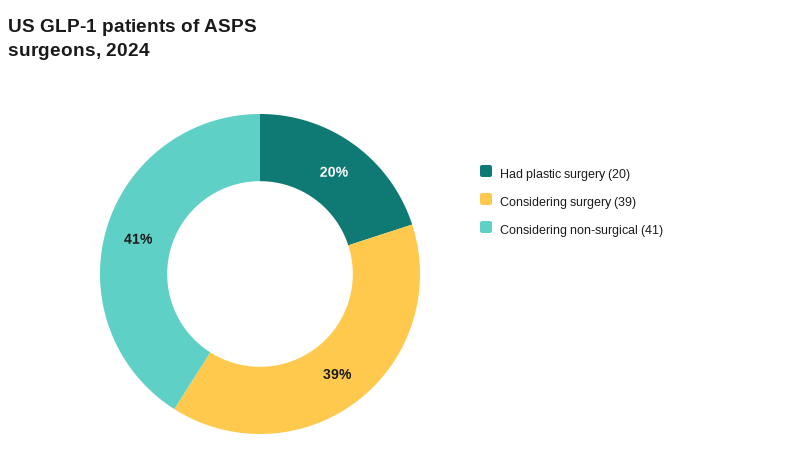
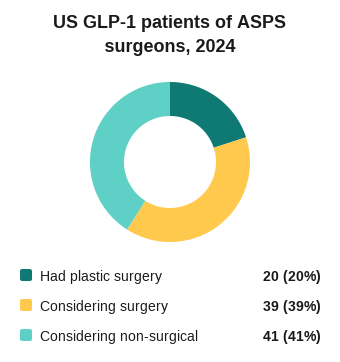
Source: ASPS 2024 release on PR Newswire. US data, patients of ASPS member surgeons only.
The chart shows how those patients split. It is a US sample of one group of surgeons’ patients. It says nothing about Australian demand, and it does not cover everyone taking GLP-1 drugs.
Panniculectomy outcomes
A 10-year review in Plastic and Reconstructive Surgery (April 2026 issue) looked at 373 patients who had a panniculectomy, the surgical removal of excess abdominal skin, between 2013 and 2023. Plastic Surgery Practice reports that 21.7% were taking GLP-1 medications before surgery, with use increasing in recent years.
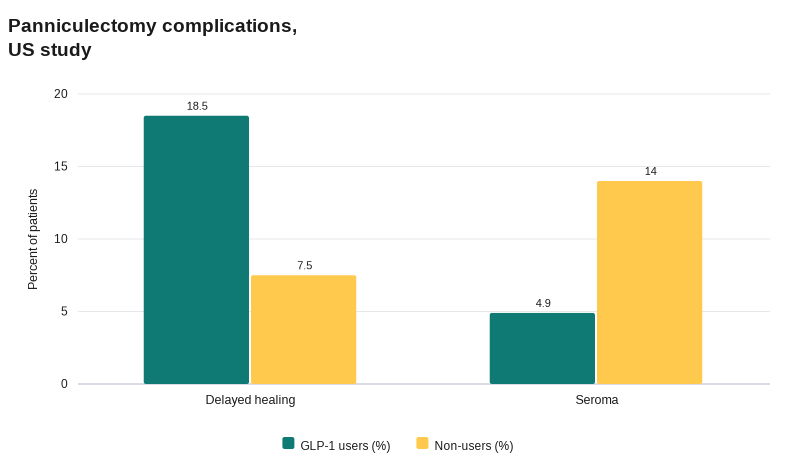
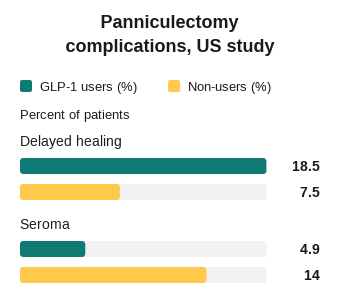
Source: Plastic Surgery Practice, “GLP-1 Medications May Affect Complications After Panniculectomy”, summarising the study.
The chart shows a trade-off in this one US sample: delayed wound healing was more common in GLP-1 users (18.5% against 7.5%), and seroma was less common (4.9% against 14.0%). We could not open the journal paper itself (paywalled), so we rely on this summary of it.
Body-contouring procedure counts in Australia, 2024
The ISAPS 2024 survey, page 33, lists 177,502 total procedures for Australia, made up of 114,188 surgical and 63,315 non-surgical. ISAPS says its totals are extrapolated from survey responses by surgeons. Treat them as estimates.
The survey’s “Body and Extremities” total for Australia is 41,160. That group is broader than post-weight-loss surgery. It includes scar revision (11,025), labiaplasty (1,733) and other procedures. So 41,160 is not a count of weight-loss contouring.
| Procedure (Australia, ISAPS 2024) | Count |
|---|---|
| Scar revision | 11,025 |
| Liposuction | 10,395 |
| Abdominoplasty (tummy tuck) | 9,975 |
| Brachioplasty (arm lift) | 2,415 |
| Lower body lift | 2,100 |
| Thigh lift | 1,785 |
| Upper body lift | 735 |
Source: ISAPS International Survey on Aesthetic/Cosmetic Procedures 2024 (PDF), Australia page.
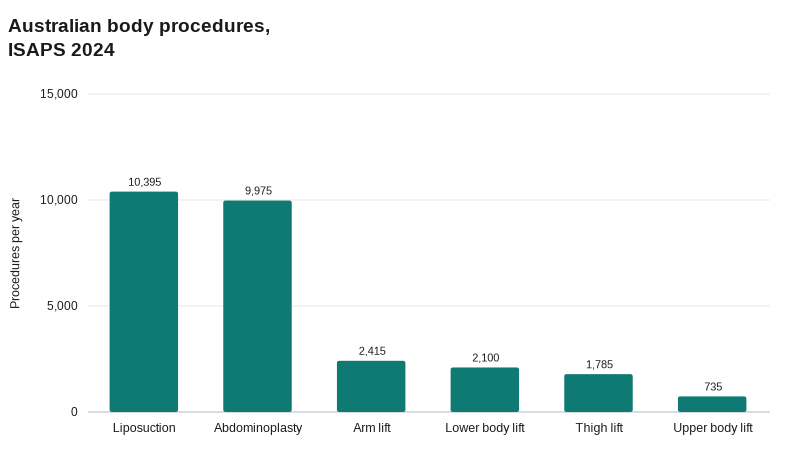
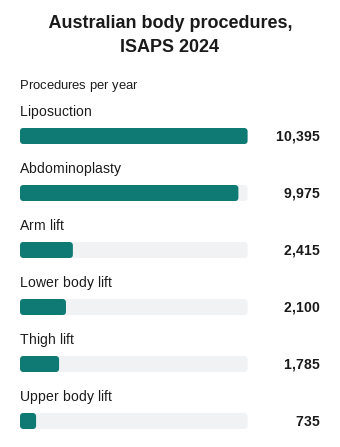
Source: ISAPS 2024 survey (PDF), Australia page.
The chart shows liposuction and abdominoplasty far ahead of the lift procedures, in the ISAPS estimates. Which of those patients lost weight on a GLP-1 drug is not recorded.
The data gap in Australia
We searched for an Australian national survey, an Ahpra data release or a peer-reviewed Australian study that counts extra body-contouring consultations linked to GLP-1 use. We did not find one. Any clinic claiming a specific Australian “GLP-1 surge” in surgery bookings is working from its own booking data, not published research.
Your own data is the best evidence you have. Ask new patients at consultation whether they have lost weight on a GLP-1 drug, and record the answer. After a few months you will know your own numbers.
Advertising rules still apply
Ahpra’s page on higher risk non-surgical cosmetic procedures says the National Law “specifically prohibits the use of testimonials or purported testimonials”. The same page allows before-and-after images only under conditions, including that both images are genuine, meaning actual patients who had the advertised procedure from that practitioner. That page does not cover surgical procedures, which fall under separate Medical Board guidance we have not reviewed here. Read the current Ahpra pages for your own procedures, or ask your registration board, before you publish.
If you want a second pair of eyes on your site’s body-contouring pages, talk to ClinicCode.
What this means for clinics
- Patients who have lost weight on a GLP-1 drug often research procedures before they book. Clear pages on procedure steps, surgeon credentials, recovery and pricing help them compare you with other clinics.
- Treat the US figures as a signal, not a forecast for your clinic. Track your own enquiry sources.
- Do not quote the national sales growth as a rise in your own demand.
For clinics that want a website and enquiry system built around this patient group, see ClinicCode.
Sources and References
- SBS News: The Ozempic-sized force turbocharging an Aussie food shake-up: used for 57,941 and 496,875 units, the nearly 500,000 users, the not-peer-reviewed note and the likely-underestimate note.
- UNSW: Making impact in health systems research: used for “nearly 500,000 Australians, almost 2% of the adult population” and the almost tenfold rise.
- BioPharmaDispatch: GLP-1s are reshaping the Australian prescription medicines market: used for 47.8% privately accessed of more than 6 million units, as quoted from the UNSW study.
- ASPS 2024 statistics release (PR Newswire): used for the 20%, 39% and 41% figures and “over 800,000”.
- Plastic Surgery Practice: GLP-1 medications and panniculectomy: used for the 373 patients, 21.7%, and the complication rates.
- ISAPS International Survey 2024 (PDF): used for all Australian procedure counts.
- Ahpra: Advertising higher risk non-surgical cosmetic procedures: used for the testimonial and before-and-after image rules.
Not opened (blocked or paywalled), so no figure here relies on them: the medRxiv preprint and its journal version, the Plastic and Reconstructive Surgery paper, and the ASPS PDF.
ClinicCode builds AHPRA-aware websites for Australian cosmetic clinics. Call me back to talk about your body-contouring patient pipeline.
Vikas Thakur
Founder, Perth. 16 years of experience from working at TPG, iiNet and Monadelphous, now helping Australian clinics keep their websites, ads and online presence AHPRA compliant.