Privacy Act Exemption? Health Clinics Never Got One
The Privacy Act generally exempts businesses with a turnover of $3 million or less. The OAIC says that does not cover a business that provides a health service.
 Vikas Thakur Founder, Perth 9 min read Fact checked
Key takeaways
- The OAIC says small businesses with an annual turnover of $3 million or less are generally exempt from the Privacy Act (s 6D)
- That exemption does not apply to an entity that provides a health service to another individual and holds any health information, other than in an employee record (s 6D(4)(b))
- The OAIC lists a dentist and an allied health professional as health service providers, and says a gym or weight loss clinic is one when it collects your health information
- The OAIC received 1,205 data breach notifications in the 2025 calendar year, and health service providers were the most commonly affected sector, with 225 notifications (19%)
- In October 2025 the Federal Court imposed $5.8 million in civil penalties on Australian Clinical Labs, which Clayton Utz describes as the first civil penalties under the Privacy Act
- Automated decision-making disclosures in privacy policies are due to start on 10 December 2026, according to law firm Allens
The Short Answer
If your clinic provides a health service and holds health information, the Privacy Act 1988 applies to you whatever your turnover. That is the OAIC’s reading of section 6D(4)(b). It is not the general small business threshold at work, and it is not a proposal.
Whether a given cosmetic treatment counts as a “health service” depends on what you do. The OAIC’s list names dentists and allied health professionals. It does not name cosmetic injectable clinics, so if you are unsure, ask a lawyer rather than assuming either way.
What the Privacy Act Actually Says
The OAIC’s Australian Privacy Principles Guidelines, Chapter B say: “Small businesses - namely, those with an annual turnover of $3 million or less - are generally exempt from the operation of the Privacy Act (s 6D). However, this exemption does not apply to an individual, body corporate, partnership, unincorporated association or trust that provides a health service to another individual and holds any health information except in an employee record (s 6D(4)(b)).”
There is no turnover figure attached to that second sentence.
The OAIC page “What is a health service provider?” says an organisation that provides a health service and holds health information is covered by the Privacy Act “even if they’re a small business or providing a health service is not their primary activity.” Its examples include a dentist, an allied health professional, and a complementary medicine therapist. It also lists “a gym or weight loss clinic”, and later says these are health service providers “in situations where they collect your health information”.
The same page says providing a health service means doing things like diagnosing or treating illness or disability, or assessing, maintaining or improving an individual’s physical or psychological health.
The Guidelines define health information to include information or an opinion about the health of an individual, and “other personal information collected to provide, or in providing, a health service”. Consultation notes, medical history forms and consent forms that record allergies or medications are the kind of records that are likely to fall under that definition. Check your own records against it.
Takeaway: If you provide a health service and hold health information, the $3 million turnover line does not decide whether the Act applies to you.
What This Means for the Build
Once coverage does not depend on revenue, three build decisions follow.
Privacy policy and collection notices. A generic template downloaded once and never updated to match your actual intake form fields is a mismatch waiting to be found. Make sure your policy names the categories of health information your forms really collect.
Intake and booking form design. Every field that captures health information (medical history, medications, previous procedures) should have a collection notice at or before the point of capture, not three clicks away in a footer link. If your booking vendor controls the form, check what it asks for and whether your policy names it.
Data breach response. The OAIC says businesses covered by the Privacy Act must report any data breach that is likely to result in serious harm to affected individuals under the notifiable data breaches scheme. The chart below shows why this sector matters.
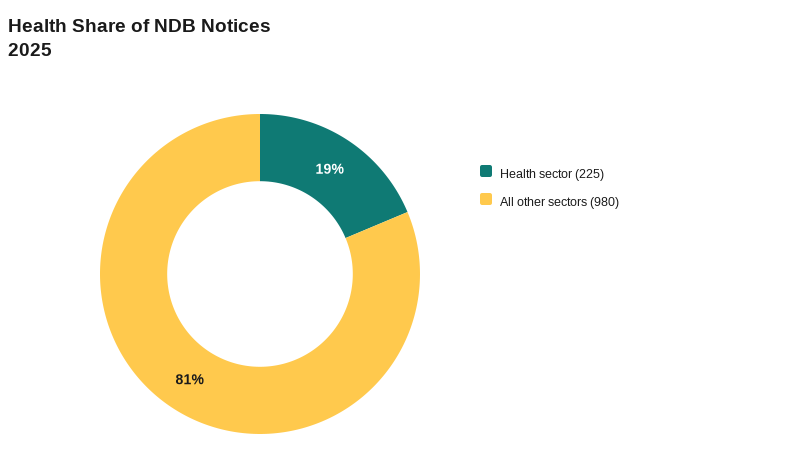
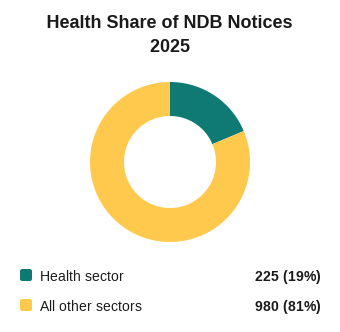
Source: OAIC, “Data breach notifications increase to all-time high in 2025, new NDB stats show”, published 6 July 2026. The OAIC reports 225 notifications from health service providers, 19% of 1,205. The “all other sectors” slice (980) is our arithmetic: 1,205 minus 225.
Separately, the OAIC says the 2025 count was an 8% increase on 2024 (1,112 notifications), and that health service providers were the most commonly affected sector.
From 10 December 2026, new APP 1.7 to 1.9 obligations require certain automated decision-making to be disclosed in privacy policies, according to Allens. Allens says the OAIC’s guidance reads this broadly and may capture software and decision-support tools, not only AI. This is a separate duty from the coverage question in this post. See our walkthrough of the ADM disclosure requirement.
Which Businesses Does the Health Service Test Reach?
This table uses only the OAIC’s published examples. It is not a ruling on any particular business.
| Business type | What the OAIC page says |
|---|---|
| Dentist | Named as an example of a health service provider covered by the Privacy Act |
| Allied health professional | Named as an example |
| Complementary medicine therapist | Named as an example |
| Gym or weight loss clinic | A health service provider “in situations where they collect your health information” |
| Cosmetic injectable clinic | Not named. Depends on whether you provide a health service and hold health information |
Source: OAIC, “What is a health service provider?” and APP Guidelines, Chapter B. The last row is our reading, not the OAIC’s.
Takeaway: For a health service provider, “holds health information” is the question that matters. The turnover figure does not.
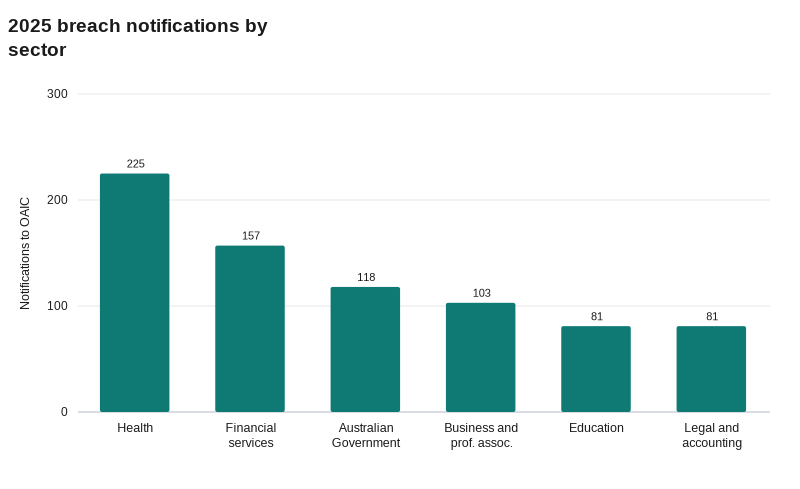
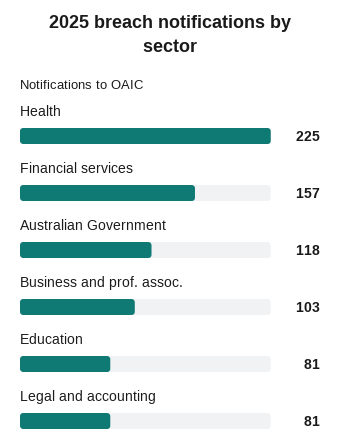
Source: OAIC, “Data breach notifications increase to all-time high in 2025, new NDB stats show”, 6 July 2026 (top sectors by volume among 1,205 notifications).
What to Check on Your Own Site
- Privacy policy is published, current, and names the categories of health information your intake and booking forms actually collect
- A collection notice appears at or before the field that captures health information, not only in a linked policy page
- Data breach response steps are written down, and someone knows who decides whether to notify the OAIC
- Your booking or practice management vendor’s terms are on file, including where patient data is hosted
- Staff access to patient records uses individual logins, not one shared password
- A retention and deletion rule exists, and enquiries that never became patients are not held indefinitely by default
- If any part of your intake flow uses automated scoring or triage logic, note it now ahead of 10 December 2026
The Penalty That Shows the Act Is Enforced
Clayton Utz reports that in Australian Information Commissioner v Australian Clinical Labs Limited (No 2) [2025] FCA 1224 (article dated 17 October 2025), the Federal Court imposed “Australia’s first civil penalties under the Privacy Act”, totalling $5.8 million. The data involved health, contact and credit card information relating to some 223,000 individuals, in IT systems ACL acquired from MedLab Pathology.
Clayton Utz says the court agreed ACL failed to take reasonable steps to protect personal information (APP 11.1(b)), and that $4.2 million was allocated to that failure and a combined $1.6 million to failures to assess and notify the breaches in time. It also notes the orders were made by consent, on an agreed penalty.
ACL is a large pathology provider, not a solo clinic, and we did not find a published OAIC determination against a small cosmetic or dental practice. The security and notification duties applied in that case are set by the Act, which applies to covered entities. Whether your arrangements are enough is a question for your lawyer.
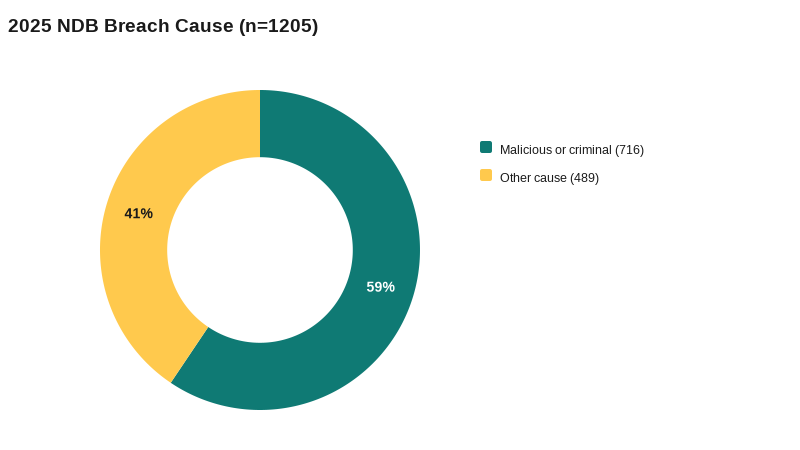
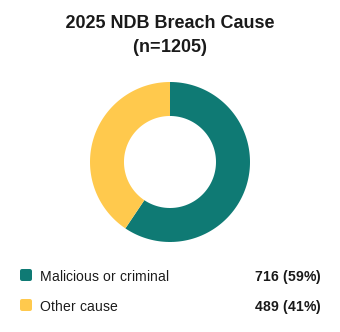
Source: OAIC, 6 July 2026. The OAIC reports 716 of 1,205 notifications attributable to malicious or criminal activity. The “other cause” slice (489) is our arithmetic: 1,205 minus 716.
Takeaway: The first civil penalties under the Act landed on a large health provider, but the duties involved are written into the Act and apply to entities of any size that are covered by it.
Where This Gets Hard
“Reasonable steps” under APP 11 depends on the facts. Clayton Utz advises that policies, procedures and systems should match the size of your organisation, your market and the sensitivity of the data you hold. We found no regulator guidance setting a bright line for a solo practitioner on a shared hosting plan with a third-party booking widget. What is reasonable in your circumstances is a question for your medical defence organisation or your lawyer.
This post also does not cover any proposal to change the general small business exemption. Check the OAIC or the Attorney-General’s Department for current status before relying on any commentary about it.
Frequently Asked Questions
Does the Privacy Act small business exemption apply to health clinics?
Not if the clinic provides a health service and holds health information. The OAIC’s APP Guidelines say the small business exemption does not apply to an entity that provides a health service to another individual and holds any health information, except in an employee record (s 6D(4)(b)). Whether a particular cosmetic service counts as a health service depends on the activity, so check with your lawyer.
What turnover makes a business a small business under the Privacy Act?
The OAIC says small businesses, namely those with an annual turnover of $3 million or less, are generally exempt from the Privacy Act (s 6D). That test does not help a business that provides a health service and holds health information.
Do the ACL penalties mean small clinics will be fined the same way?
No. The Australian Clinical Labs case involved a large pathology provider, and the penalty was agreed. We did not find a published OAIC determination against a small cosmetic or dental practice. The security and notification duties that case applied still apply to any entity covered by the Act.
Get Your Privacy Policy and Intake Forms Checked
If you want a second set of eyes on whether your privacy policy matches what your booking and intake forms collect, get in touch and ClinicCode will walk through it with you.
Sources
- OAIC - Australian Privacy Principles Guidelines, Chapter B: Key concepts (s 6D, s 6D(4)(b), health information, health service examples).
- OAIC - What is a health service provider?
- OAIC - Data breach notifications increase to all-time high in 2025, new NDB stats show, published 6 July 2026.
- Clayton Utz - Landmark privacy penalty: what the ACL case means for data protection in Australia, 17 October 2025.
- Allens - Mandatory automated decision-making disclosure requirements are coming, 2 October 2026.
Vikas Thakur
Founder, Perth. 16 years of experience from working at TPG, iiNet and Monadelphous, now helping Australian clinics keep their websites, ads and online presence AHPRA compliant.