Naming Botox on Your Website: Up to $18.2m for a Company
The TGA treats naming Botox, or hinting at it with terms like BTX or wrinkle reduction injections, as advertising a prescription medicine. Here is what its guidance says and what a breach can cost.
 Vikas Thakur Founder, Perth 13 min read Fact checked
You cannot treat “Botox” as a safe word on a clinic website. The TGA’s guidance on advertising prescription medicines says advertising them to the public is prohibited under subsections 42DL(10) and 42DLB(7) of the Therapeutic Goods Act 1989, and its list of references to a prescription medicine starts with the product name Botox. The maximum civil penalty the TGA gives for a corporation is 50,000 penalty units, which is $18.2 million at the current penalty unit value (our arithmetic, with the inputs shown below).
Key takeaways
- The TGA says advertising prescription medicines to the public is prohibited under subsections 42DL(10) and 42DLB(7) of the Therapeutic Goods Act 1989, with limited exceptions (TGA guidance).
- The TGA’s own examples of a reference to a prescription medicine include the product name Botox, the abbreviation BTX, the nicknames Tox and Haytox, and the class term “wrinkle reduction injections” (TGA guidance).
- A generic swap is not a safe fix. In March 2024 the TGA said it no longer permits terms such as “wrinkle reducing injections” where a reasonable consumer would understand the content is promoting a prescription medicine, and that express references such as “Botox” or “botulinum toxin” were never permitted (TGA, 7 March 2024).
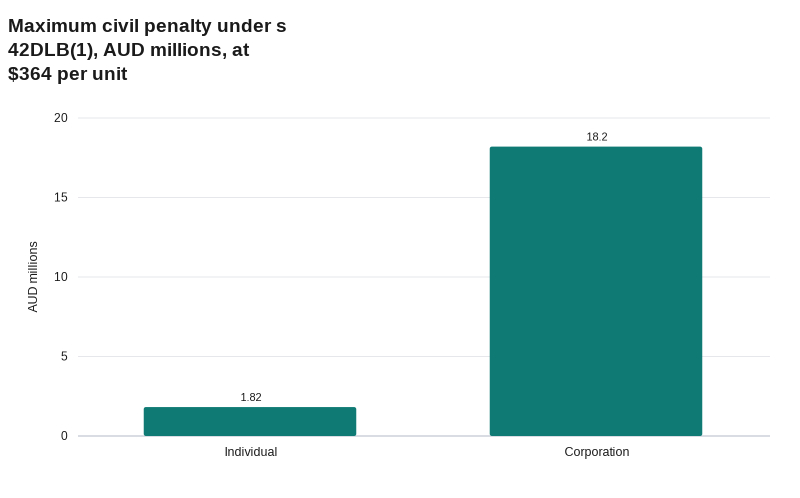
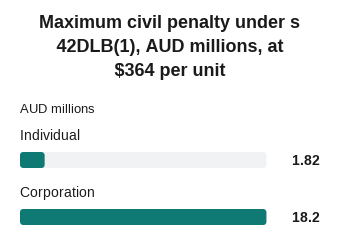
- The maximum a court can impose under subsection 42DLB(1) is 5,000 penalty units for an individual and 50,000 for a corporation (TGA). At $364 per unit that is $1.82 million and $18.2 million, as the TGA also states on its nicotine pouches page.
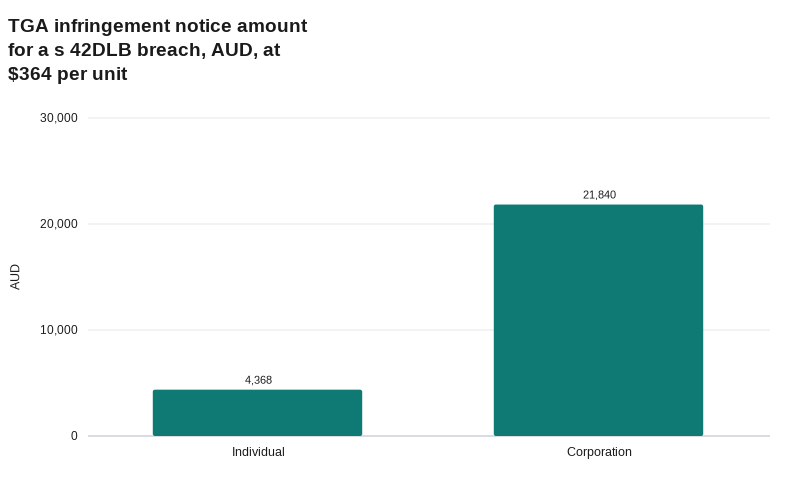
- The TGA infringement notice amounts for the same breach are 12 penalty units for an individual and 60 for a corporation, which the TGA works out as $4,368 and $21,840 (TGA).
- The TGA says its examples cover all forms of media and communication, and that business names, logos, booking systems and price lists can all count as advertising (TGA guidance).
- The TGA says it requested removal of over 13,700 alleged unlawful advertisements or seller profiles from online platforms in 2024-25, across all therapeutic goods, not only cosmetic injectables (TGA).
The short answer
If your website says “we offer Botox”, the TGA’s published guidance treats that as a direct reference to a prescription medicine. The guidance also treats indirect references the same way: the abbreviation BTX, nicknames like Tox and Haytox, and class terms like “wrinkle reduction injections” all appear in its list of examples (TGA guidance).
The rule is about what the advertisement refers to, not only which brand it names. The TGA says the same advertising rules apply to substances, and goods containing substances, in Schedule 3, 4 or 8 of the Poisons Standard, unless included in Appendix H (TGA guidance). A prescription product name, an ingredient name, an abbreviation and a class description are all treated as references.
What the TGA says about generic terms
In our view, the obvious workaround is to swap the brand for “anti-wrinkle injections” or “botulinum toxin”. The TGA’s guidance does not support that as a safe approach.
In its 7 March 2024 notice, the TGA said it had historically allowed generic non-product-specific terms such as “wrinkle reducing injections” in cosmetic health service advertising, but that express references to products or ingredients themselves, such as “Botox” or “botulinum toxin”, were not permitted. It then said it no longer permits terms such as “wrinkle reducing injections” where those terms would result in a reasonable consumer understanding that the content is intended to promote the use or supply of a prescription medicine.
The current TGA guidance on advertising health services (last updated 18 June 2026) repeats this: it says advertising that refers to a class of goods used in a health service includes terms that act as substitutes for direct references, and gives “wrinkle reducing injections” as one example. The guidance on prescription medicine advertising also lists “cosmetic injectables” among the common ways businesses promote themselves as a service for prescribing or supplying prescription medicines.
So there is no TGA-approved cosmetic substitute wording to copy. The TGA’s general guide is that promoting the type of practitioner consultation offered, or the conditions a service can treat, without directly or indirectly referring to therapeutic goods, is unlikely to constitute advertising of therapeutic goods. On the same TGA page, the worked example is a migraine consultation (‘Call our clinic for a consultation to discuss treatment options for migraine’), not a cosmetic one, so it does not hand you approved cosmetic wording. Whether a particular sentence is safe is a legal question, and the TGA tells advertisers to seek independent legal advice.
What a breach can cost
The TGA’s infringement notice page sets out the maximum a court can impose under subsection 42DLB(1) of the Act: 5,000 penalty units for an individual and 50,000 penalty units for a corporation. The same page gives the Commonwealth penalty unit as $364 as at 1 July 2026. The Crimes (Amount of a Penalty Unit) Instrument 2026 sets the amount at $364 and notes that it applies only to offences committed on or after 1 July 2026.
Our arithmetic from those inputs: 5,000 x $364 = $1,820,000 and 50,000 x $364 = $18,200,000. The TGA’s nicotine pouches page states the same civil penalty figures ($1.82 million and $18.2 million) for advertising and supply offences. These are maximums a court can impose, not typical outcomes.
Source: TGA, Information about infringement notices for the 5,000 and 50,000 penalty unit maximums and the $364 unit value; dollar figures are our arithmetic (units x $364), seen 24 November 2026.
The TGA can also issue infringement notices. Its page works the amounts out as the lesser of one-fifth of the maximum and a fixed unit count, which gives 12 penalty units for an individual and 60 for a corporation.
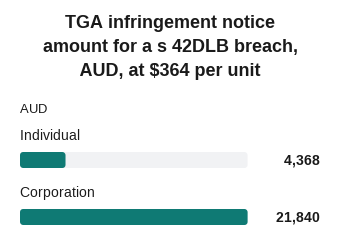
Source: TGA, Information about infringement notices, worked example at $364 per penalty unit as at 1 July 2026, seen 24 November 2026.
What that means for the build
For a developer or practice manager, the practical question is where a reference to a prescription medicine can appear. The TGA says its examples are relevant to all forms of media and communication. Its guidance names these surfaces directly:
- Business names and logos. A business name or logo that refers to a prescription medicine may count as advertising if it suggests the business provides services involving that medicine. The TGA includes graphics of syringes, applicator pens and vials as images that can impliedly refer to a prescription medicine (TGA guidance).
- Price lists. The TGA says listing prices for treatments that involve or reference prescription medicines, whether as a total cost or cost per unit, is likely to amount to advertising of those medicines. Its example of a non-compliant clinic website is one that shows cost per unit and package deals for botulinum toxin and dermal fillers (TGA guidance).
- Booking systems. A publicly available booking system or catalogue that lists prescription medicines by name as treatments may amount to advertising of them, and the TGA gives a “wrinkle-reduction services” booking example as non-compliant (TGA guidance).
- Content behind a login. The TGA says promoting prescription medicines behind a login, paywall or membership may still be unlawful advertising to the public (TGA guidance).
- Before and after photos. Using them is not prohibited by the Act, but if it is expressly or implicitly suggested that the “after” photo is due to a prescription medicine, that is likely to amount to advertising the medicine (TGA guidance).
In our view, because the TGA treats the test as applying to any statement or design intended to promote use or supply, page titles, meta descriptions, image file names, alt text, structured data fields and embedded social feeds should be checked against the same list of terms. The TGA pages we read do not list those surfaces by name, so this is our reading, not a TGA statement.
What the TGA lists as a reference to a prescription medicine
The table below restates the TGA’s own examples. It is not a list of approved wording.
| Type of reference (TGA wording) | TGA examples |
|---|---|
| Product name or trade name | Botox |
| Abbreviation or acronym | BTX (named in the guidance text) |
| Class of prescription medicines, including via substitute terms | Wrinkle reduction injections; weight-loss injections; peptides |
| Colloquial name or nickname | Tox, Haytox |
| Images or designs that impliedly refer to the medicine | Graphics of syringes, applicator pens or vials associated with prescription medicines |
Source: TGA, Complying with the restrictions on advertising prescription medicines to the public, Table 1 and surrounding text (published 18 June 2026, last updated 23 June 2026), seen 24 November 2026. The table lists TGA examples only; it does not state that any other wording is compliant.
What to check on your own site right now
- Search your CMS for product names, ingredient names, abbreviations such as BTX and nicknames such as Tox, and for class phrases such as “wrinkle reduction injections” and “cosmetic injectables”.
- Check your business name, logo and any syringe, vial or pen graphics.
- Check any price list, per-unit price and package deal that involves a prescription medicine.
- Check your booking platform’s treatment labels, since the TGA treats a public booking system as a possible advertisement.
- Check any members-only or login area that promotes these treatments.
- Check page titles, meta descriptions, image file names and alt text (our reading, as above).
Has the TGA enforced this?
We did not find a TGA enforcement action against a cosmetic clinic for naming a botulinum toxin product on a website, so we are not claiming one. What we did verify:
- The TGA’s 2024-25 key compliance summary says it commenced its first targeted campaign focused on cosmetic injectables, gave 30 infringement notices (mostly for alleged unlawful advertising of therapeutic goods, across all products) and requested removal of over 13,700 alleged unlawful advertisements or whole user or seller profiles from online platforms.
- The TGA’s 23 July 2019 release says the Federal Court ordered Peptide Clinics Australia to pay $10 million for breaches of the mandatory rules for advertising of medicines, including the ban on advertising prescription-only medicines to the public. It lists advertising Schedule 4 substances on the website and social media among the contraventions. That case involved peptides, not botulinum toxin.
- On 14 November 2023 the TGA issued 45 infringement notices totalling $742,500 to InstantScripts Pty Ltd for alleged unlawful advertising of prescription-only medicines in connection with a telehealth service. The notices were later withdrawn as part of a settlement of the company’s judicial review proceedings, and the TGA’s settlement notice says InstantScripts agreed not to make material changes to its online prescription service until the earlier of 30 June 2025 or the publication of further TGA guidance. An infringement notice is an allegation, not a finding.
Where this gets hard
The TGA’s guidance is guidance. It says it is not intended to address every aspect of the relevant legislation or all advertising scenarios, and that you should seek independent legal advice. Whether a particular page crosses the line depends on the surrounding context, which the TGA says it considers when judging whether a reference is indirect.
The TGA also ran a consultation titled “Improvements to the Therapeutic Goods Advertising Code”, which opened on 9 July 2026 and closed on 3 September 2026. The consultation page says the paper sets out options for change and, in some cases, identifies a preferred option. We did not verify whether any outcome has been published since, so check the TGA site before relying on today’s wording.
If you are a registered health practitioner, the TGA rules sit alongside Ahpra’s rules, which are a separate layer. On 2 September 2025 Ahpra said new guidelines for registered health practitioners performing and advertising non-surgical cosmetic procedures came into effect, and that the guidelines now apply to all regulated professions. Meeting one set of rules does not mean you have met the other.
Status
The TGA guidance pages we cite were published or updated in June 2026 and describe the rules as they apply now. They are not a proposal. If your site currently names a prescription product or uses the substitute terms above on a public page, the TGA’s own guidance treats that as a reference to a prescription medicine today.
Start by checking your own content against the list above, and if you would like a second set of eyes on the build, book a call with ClinicCode.
The Source Pages
Screenshots of the pages cited in this post, taken on 24 November 2026 and framed on the passage each one supports.
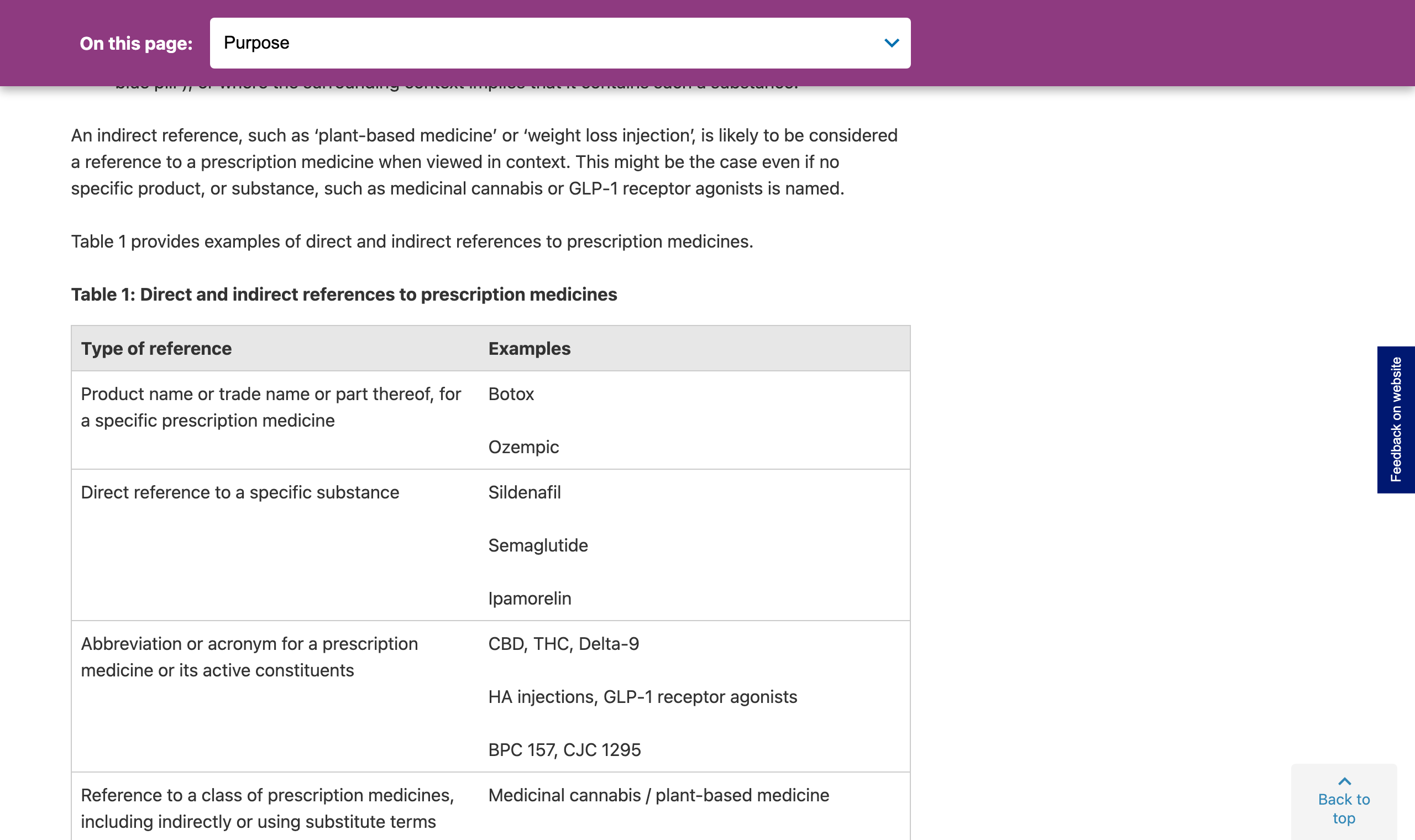
Source: TGA, Complying with the restrictions on advertising prescription medicines to the public, screenshot taken 24 November 2026.
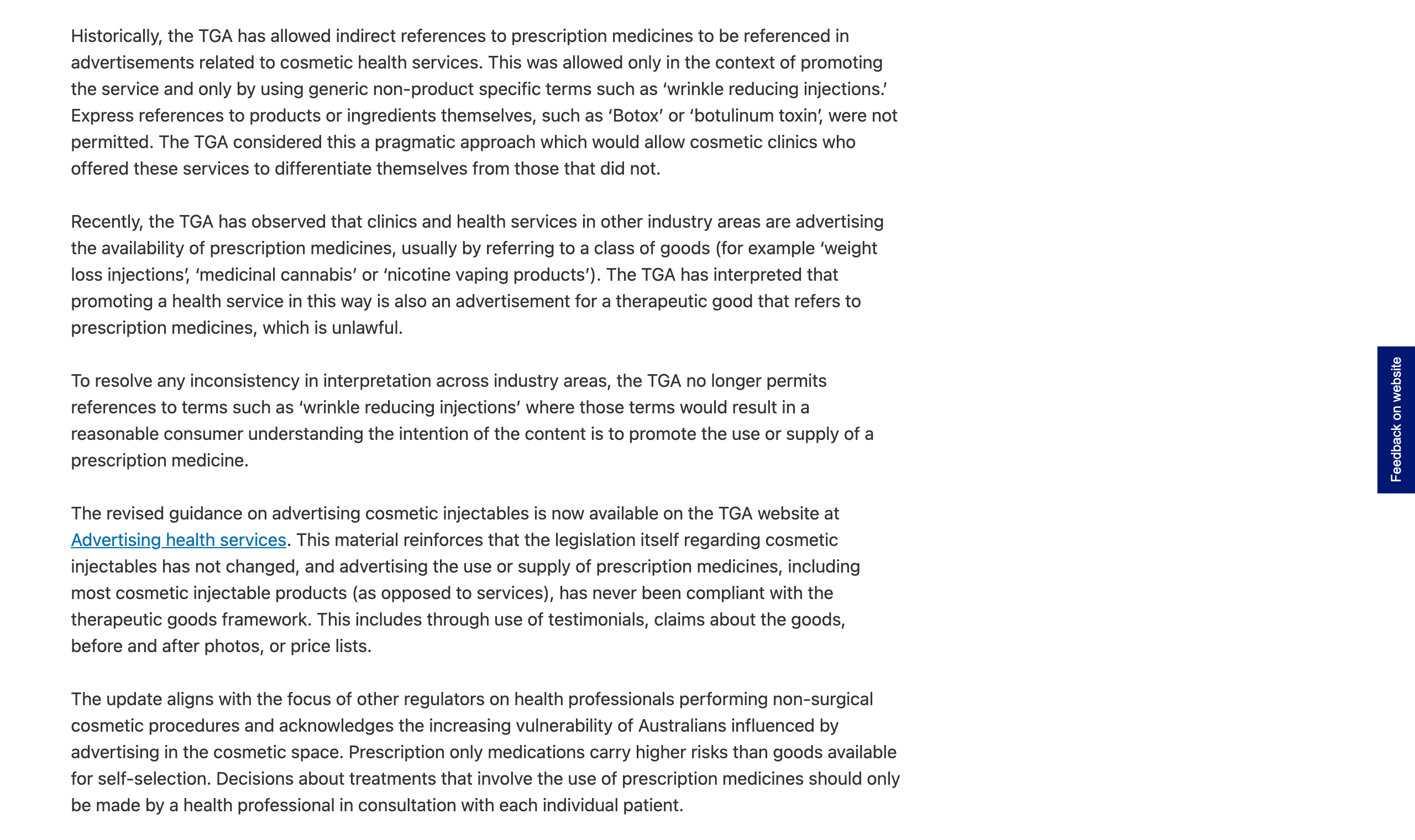
Source: TGA, Referring to cosmetic injectables in advertising, screenshot taken 24 November 2026.
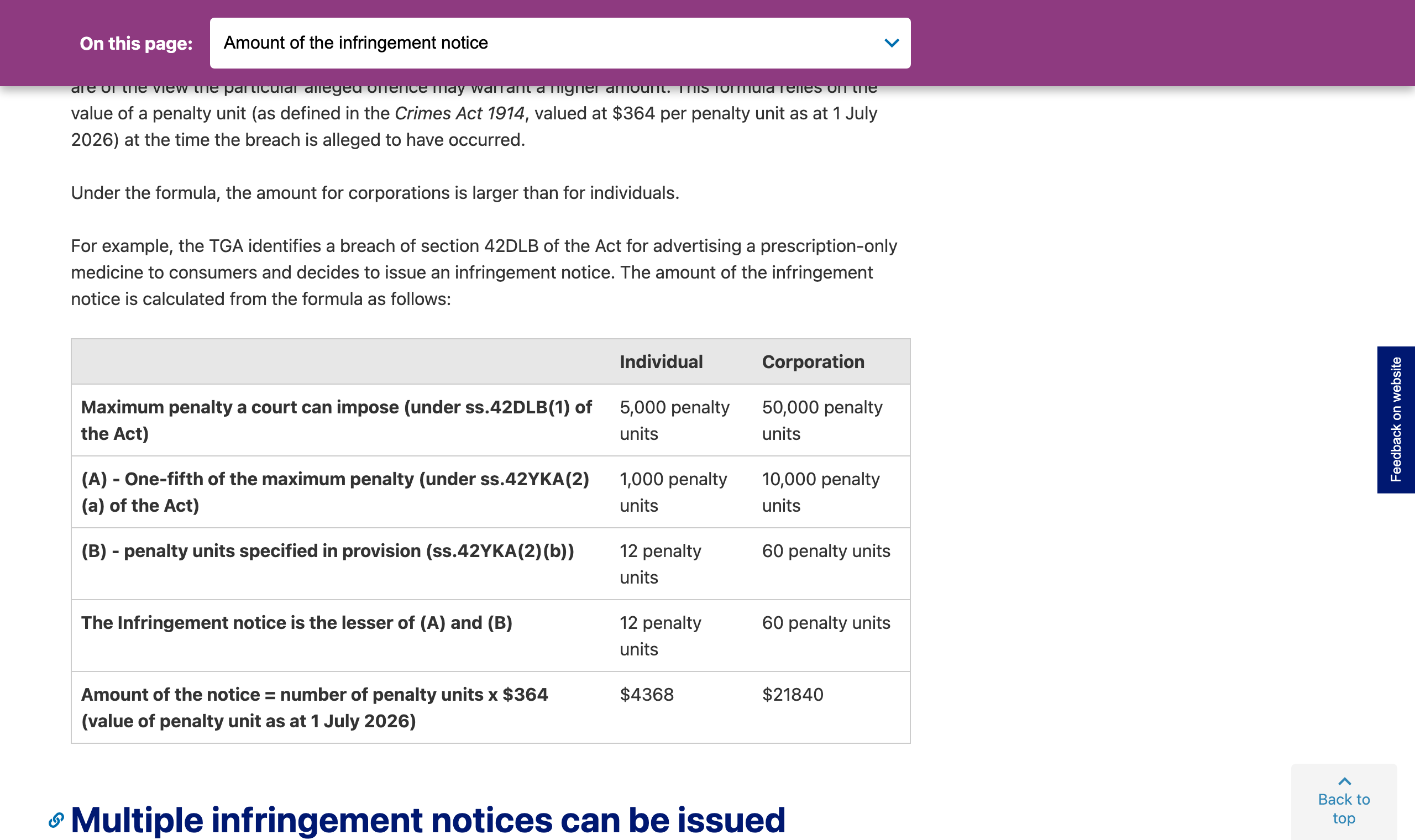
Source: TGA, Information about infringement notices, screenshot taken 24 November 2026.
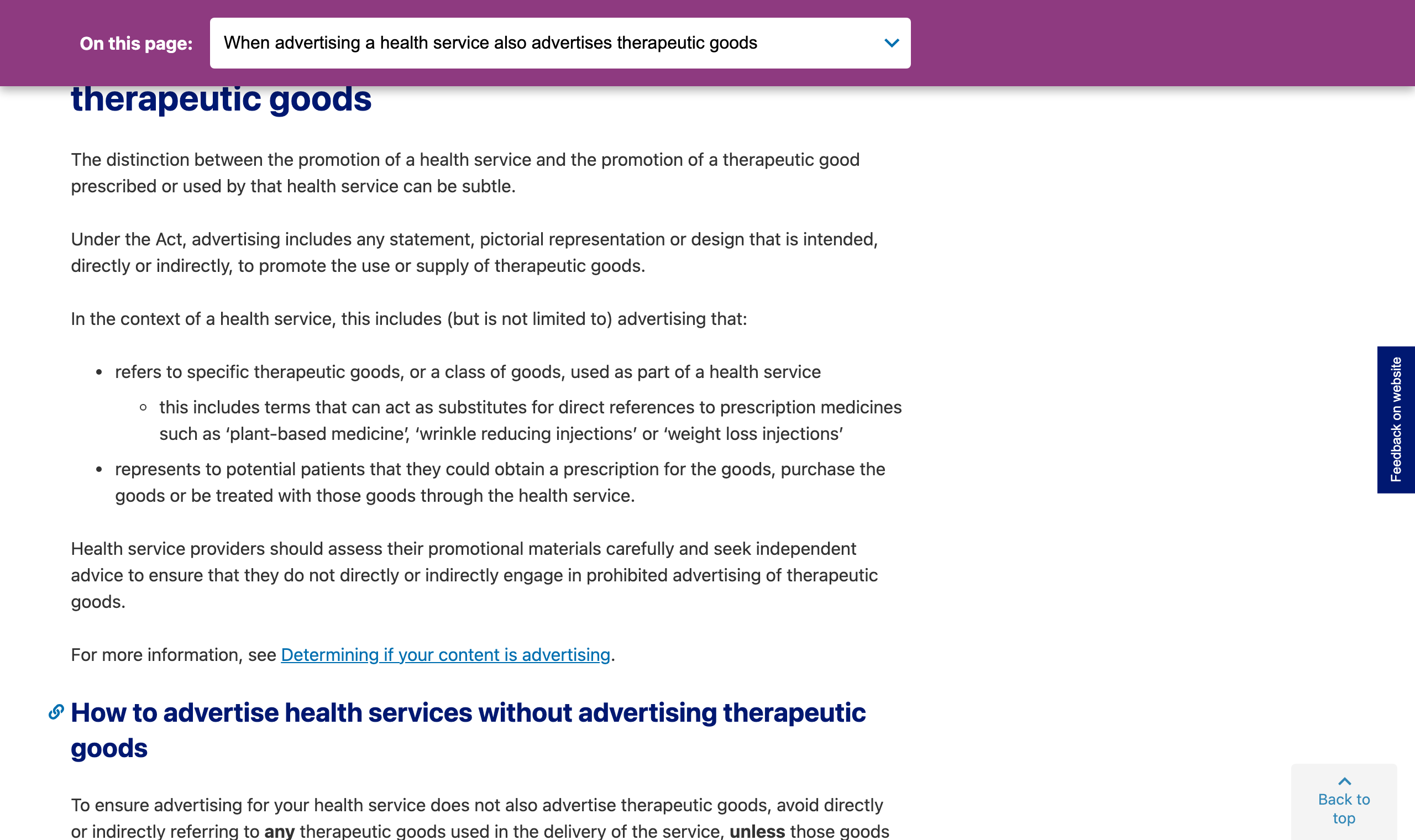
Source: TGA, Advertising health services that involve therapeutic goods, screenshot taken 24 November 2026.
Frequently Asked Questions
Can I name Botox on my clinic website in Australia?
The TGA says no. Its guidance says advertising prescription medicines to the public is prohibited under subsections 42DL(10) and 42DLB(7) of the Therapeutic Goods Act 1989, and it lists Botox as an example of a product name that counts as a reference to a prescription medicine. It also lists abbreviations such as BTX and class terms such as wrinkle reduction injections, so swapping the brand for a generic phrase is not a safe fix.
What is the actual penalty for naming a prescription medicine in an ad?
The TGA’s infringement notice page gives the maximum a court can impose under subsection 42DLB(1) as 5,000 penalty units for an individual and 50,000 penalty units for a corporation. At the TGA’s stated penalty unit value of $364 (as at 1 July 2026), that is $1,820,000 and $18,200,000 (our arithmetic). Those are maximums, and a court decides the actual penalty.
Can I use a hashtag or abbreviation like #BTX instead of the brand name?
The TGA’s guidance on advertising prescription medicines lists abbreviations and acronyms for a prescription medicine, and colloquial names or nicknames such as Tox and Haytox, as references to a prescription medicine. It also says a class reference such as wrinkle reduction injections is one. A hashtag does not change that, though the guidance does not discuss hashtags specifically.
Need a hand with your website?
If you want a second pair of eyes on how this applies to your own site, request a callback and we will talk it through.
Sources and references
- TGA, Complying with the restrictions on advertising prescription medicines to the public (published 18 June 2026, updated 23 June 2026). Seen 24 November 2026.
- TGA, Advertising health services that involve therapeutic goods (updated 18 June 2026). Seen 24 November 2026.
- TGA, Referring to cosmetic injectables in advertising (7 March 2024). Seen 24 November 2026.
- TGA, Information about infringement notices. Seen 24 November 2026.
- Crimes (Amount of a Penalty Unit) Instrument 2026, Federal Register of Legislation F2026N00424. Seen 24 November 2026.
- TGA, Nicotine pouches (civil penalty maximums). Seen 24 November 2026.
- TGA, $10 million penalty ordered against Peptide Clinics Pty Ltd for advertising breaches (23 July 2019). Seen 24 November 2026.
- TGA, WITHDRAWN - InstantScripts Pty Ltd fined $742,500 (14 November 2023, updated 13 November 2024). Seen 24 November 2026.
- TGA, TGA and InstantScripts reach settlement (13 November 2024). Seen 24 November 2026.
- TGA, Key compliance activities for Financial Year 2024-25. Seen 24 November 2026.
- TGA, Improvements to the Therapeutic Goods Advertising Code consultation (closed 3 September 2026). Seen 24 November 2026.
- Ahpra, New guidelines for cosmetic procedures (2 September 2025). Seen 24 November 2026.
Last reviewed: 24 November 2026.
Vikas Thakur
Founder, Perth. 16 years of experience from working at TPG, iiNet and Monadelphous, now helping Australian clinics keep their websites, ads and online presence AHPRA compliant.