Clear Aligner vs Braces Cost Australia: Price Data [2026 Guide]
Orthodontics Australia’s guide puts clear aligners at $8,000 to $10,000 and metal braces at $7,000 to $9,000 for a full course of treatment. We compare prices across four options and report one 2024 study from India on treatment time, which is not Australian data.
 Vikas Thakur Founder, Perth Updated Nov 25, 2026 9 min read Fact checked
Key takeaways
- Clear aligners cost $8,000 to $10,000 for a full course in Australia, per Orthodontics Australia (page dated 16 June 2025)
- Metal braces cost $7,000 to $9,000, ceramic braces $7,500 to $10,000 and lingual braces $10,000 to $12,000 on the same page
- On those ranges, aligners start $1,000 above metal braces at the low end and top out $1,000 above them at the high end (our arithmetic: $8,000 - $7,000 and $10,000 - $9,000)
- A 2024 retrospective study of patients aged 12 to 18 at one tertiary care centre, by authors at institutions in India (not Australian data; Aref et al., Journal of Pharmacy and Bioallied Sciences) reported a mean treatment time of 18 months for Invisalign against 24 months for conventional braces (P < 0.001)
- The same study reported a somewhat higher share of relapse cases with Invisalign, but the difference was not statistically significant (P > 0.05)
- Orthodontics Australia says Medicare does not cover orthodontic treatment, and any private health rebate depends on your policy, provider and level of extras cover
Orthodontics Australia’s guide puts clear aligners at $8,000 to $10,000 and metal braces at $7,000 to $9,000 for a full course in Australia. That is the headline number, and it is not the whole story. One 2024 study from India found Invisalign patients finished faster on average, but it covered teenagers at a single centre and is not Australian data, so it is not a promise for every adult case. The guide also says the right price depends on the duration and complexity of treatment and the option you choose, so the ranges below are a guide, not a quote.
This guide sets out what each option costs, what the one clinical study we found (from India, not Australia) says about treatment time, and what Orthodontics Australia says about case suitability. We anchor every price to Orthodontics Australia’s cost page, which says it is medically reviewed by the Australian Society of Orthodontists, rather than to individual practice pages.
What Clear Aligners and Braces Cost in Australia
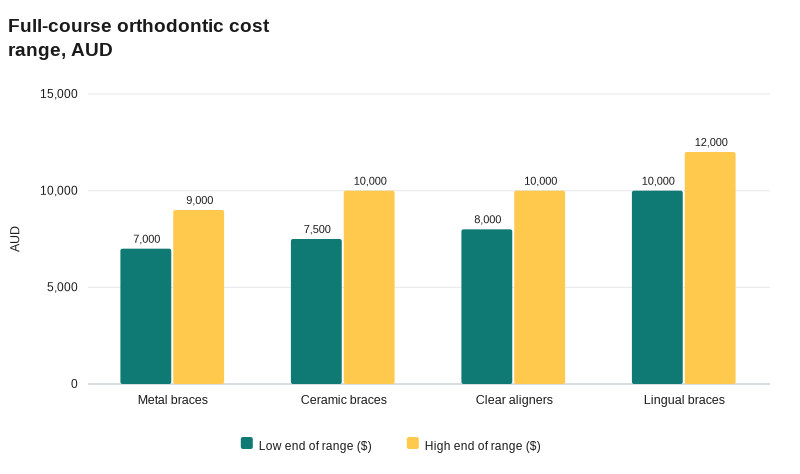
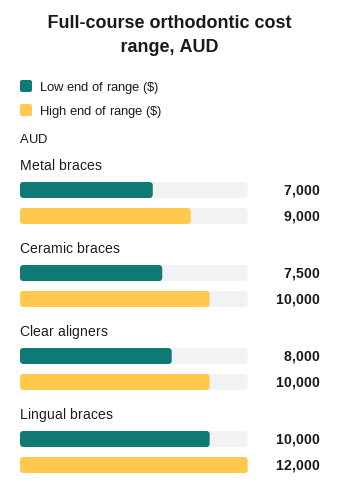
Source: Orthodontics Australia, “How much do braces cost?”, page dated 16 June 2025, seen 24 November 2026. Figures are AUD ranges for a full course of orthodontic treatment, as quoted by Orthodontics Australia.
| Treatment | Low end of range | High end of range |
|---|---|---|
| Metal braces | $7,000 | $9,000 |
| Ceramic braces | $7,500 | $10,000 |
| Clear aligners | $8,000 | $10,000 |
| Lingual braces | $10,000 | $12,000 |
Source: Orthodontics Australia, “How much do braces cost?”, page dated 16 June 2025, seen 24 November 2026. AUD, full course of treatment.
Orthodontics Australia notes these prices are typically for a 15 to 18 month treatment period that also helps align the jaw, and include regular consultations to monitor progress. It also says fees may differ if other appliances are needed, such as expansion plates, anchorage implants or bite correcting springs. Its page lists “clear aligners” as a category and does not name Invisalign specifically, so we treat the clear aligner range as the guide for Invisalign.
Takeaway: On these ranges, metal braces are the lowest-priced option and lingual braces the highest. Because each orthodontist sets their own fees, get an all-inclusive written quote before you compare.
Why Quotes From Practices Differ
Orthodontics Australia says each orthodontist is free to set their own fees, so some variation between practices is to be expected, and prices also depend on the work being done and where you live. Its advice is to obtain an all-inclusive quote in writing from a couple of local orthodontists and to check what the quote includes.
We have not used individual practice pricing pages in this guide. They do not cite a shared source, and we could not compare them like for like, because a short course on a few front teeth is a different product from a full course.
Takeaway: Compare quotes only when each one states what it includes, such as consultations, records, retainers and any extra appliances.
Ceramic and Lingual Braces
Ceramic braces are priced by Orthodontics Australia at $7,500 to $10,000 and lingual braces at $10,000 to $12,000. From those figures, ceramic braces sit $500 above metal braces at the low end and $1,000 above at the high end (our arithmetic). The page gives the prices, not the reasons for the differences, so we do not attribute the gap to a particular cause here.
Takeaway: If appearance is the deciding factor, put ceramic, lingual and clear aligner quotes side by side and ask each practice what is included.
Treatment Time: What One 2024 Indian Study Found
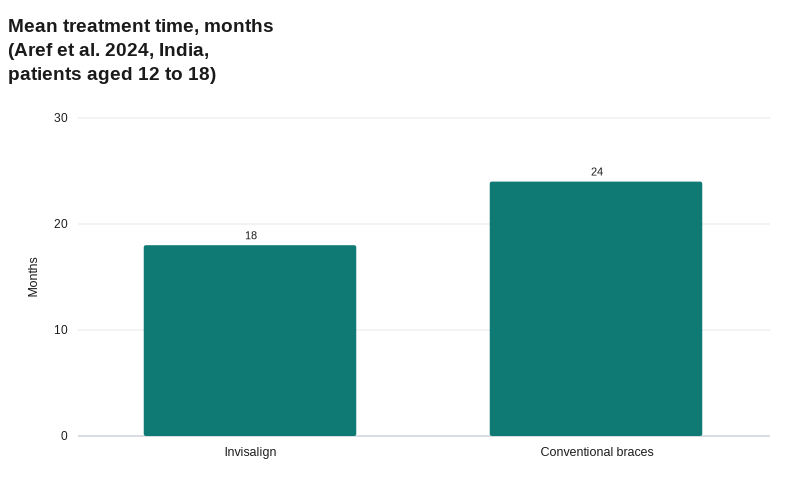
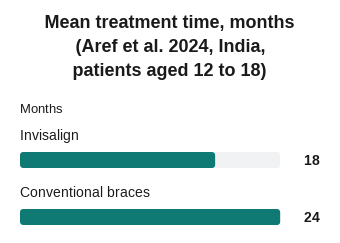
Source: Aref et al., “Comparative Analysis of Braces and Aligners: Long-Term Orthodontic Outcomes”, Journal of Pharmacy and Bioallied Sciences, 2024 (PubMed), seen 24 November 2026. Figures are mean months of treatment in a retrospective study at one tertiary care centre, 2020 to 2022. The authors’ affiliations on PubMed are all in India (Maharashtra, Gujarat, Telangana and Madhya Pradesh), so this is not Australian data.
The authors, whose affiliations on PubMed are all in India, analysed patients aged 12 to 18 treated at a tertiary care centre between 2020 and 2022. They report a mean treatment time of 18 months for Invisalign and 24 months for conventional braces (P < 0.001). Both approaches had 88 to 90 percent success rates in treating malocclusion. Invisalign was associated with a somewhat greater share of relapse cases, but the authors report the difference was not statistically significant.
Two cautions follow. The study population was teenagers at one centre, the authors are based in India, and the paper is not Australian data, so it is evidence of a difference in that group, not a timeline for every Australian adult case. And it sits alongside Orthodontics Australia’s own figure of 15 to 18 months for typical treatment periods, which is a different measure from a study mean.
Takeaway: In this one study, Invisalign patients finished sooner on average. Ask your orthodontist for a timeline based on your own teeth and bite.
Case Suitability
Orthodontics Australia recommends you always consult a specialist orthodontist before any type of treatment, including clear aligners, to understand whether your preferred option or a limited treatment will be suitable and safe for your smile in the long term. It also describes limited treatment as a cosmetic treatment that only fixes the appearance of the front teeth rather than bite or tooth issues, and says it can cause ongoing discomfort, complications or relapse.
We do not publish a share of cases that suit aligners, because we did not find a source for one. The Aref study’s conclusion is that the choice of modality should be based on patient satisfaction, treatment objectives and case complexity.
Takeaway: The deciding factor is whether your specific teeth and bite suit the treatment, which only a specialist can assess.
When Aligners Are Step One in a Bigger Smile Makeover
Some patients plan cosmetic work beyond straightening, such as veneers or bonding. In our view, a dentist may sensibly settle tooth position before quoting that work. Our smile makeover cost guide covers how combined treatment is priced, so use this page for the standalone straightening comparison and that one for the wider plan.
Takeaway: Price the straightening course as its own line item before pricing any work that depends on it.
Does Insurance Cover Either Option?
Orthodontics Australia states that orthodontic treatments are not covered by Medicare. If you have private health insurance you might be covered depending on your policy, provider and level of extras cover, and it says basic extras cover generally does not include orthodontics, so you will usually need a higher level of cover to receive a rebate. It also says the Child Dental Benefits Schedule does not cover orthodontic treatment such as braces. Check your own policy for limits and waiting periods before you commit.
Source: Orthodontics Australia, “How much do braces cost?”, page dated 16 June 2025, seen 24 November 2026.
Takeaway: Ask your fund whether orthodontics is on your level of cover, and what it pays for aligners and braces, before you choose.
AHPRA’s Advertising Rules Apply to Invisalign Marketing Too
Dental practices advertise a regulated health service, so Ahpra’s rules apply to their Invisalign pages. Ahpra’s Advertising guidelines page says the National Law prohibits advertising a regulated health service in a way that uses testimonials, and that the prohibition applies to recommendations or positive statements about the clinical aspects of a regulated health service. Our breakdown of AHPRA’s advertising rules for cosmetic dentistry goes through what that means for a dental website.
If your practice’s Invisalign landing page has not been checked against the current rules, ClinicCode can flag what needs to change before it turns into a complaint.
Takeaway: An Invisalign case study or patient review is still advertising of a regulated health service, and the testimonial rule applies to it.
The Source Pages
Screenshots of the pages cited in this post, taken on 24 November 2026 and framed on the passage each one supports.
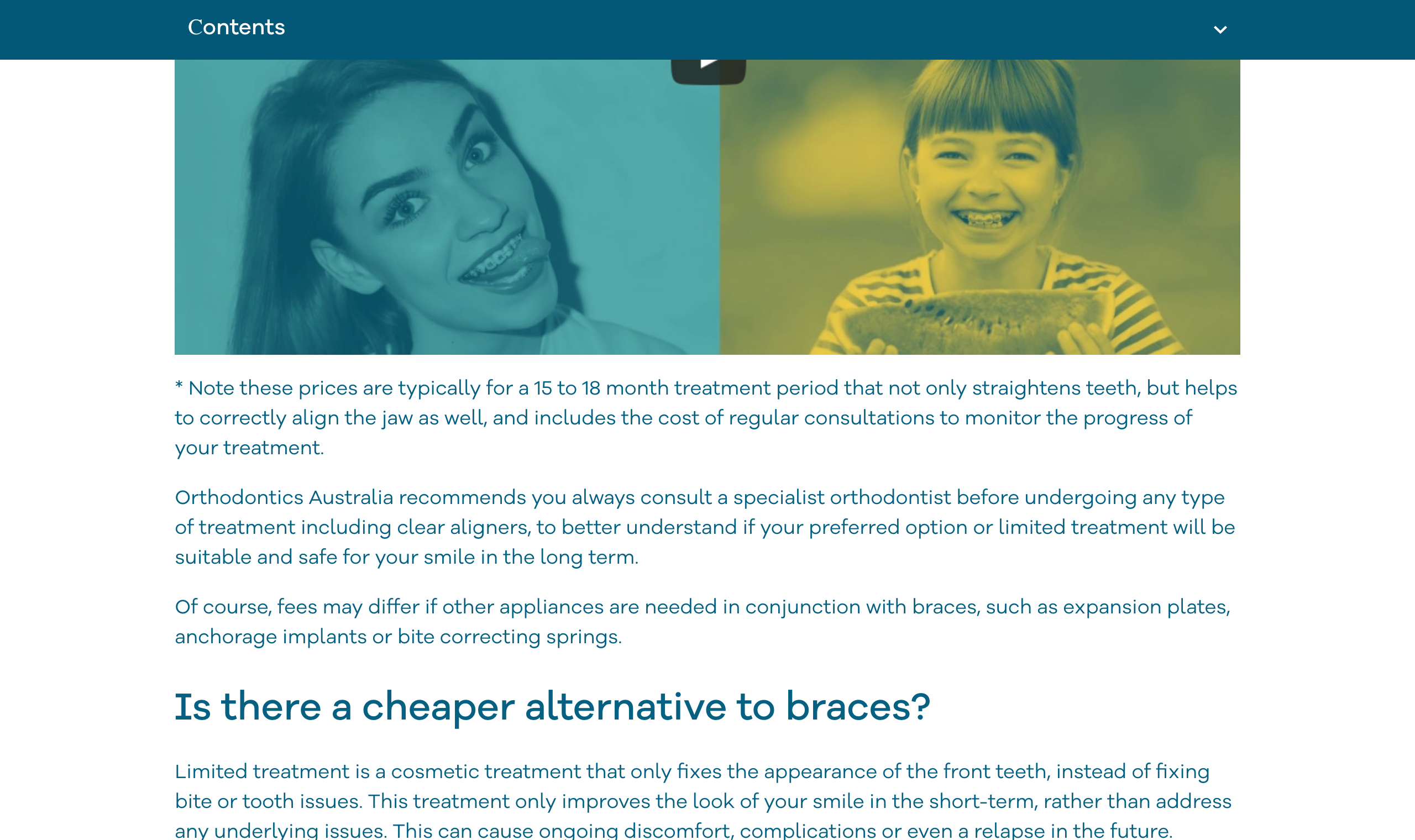
Source: Orthodontics Australia, How much do braces cost?, screenshot taken 24 November 2026.
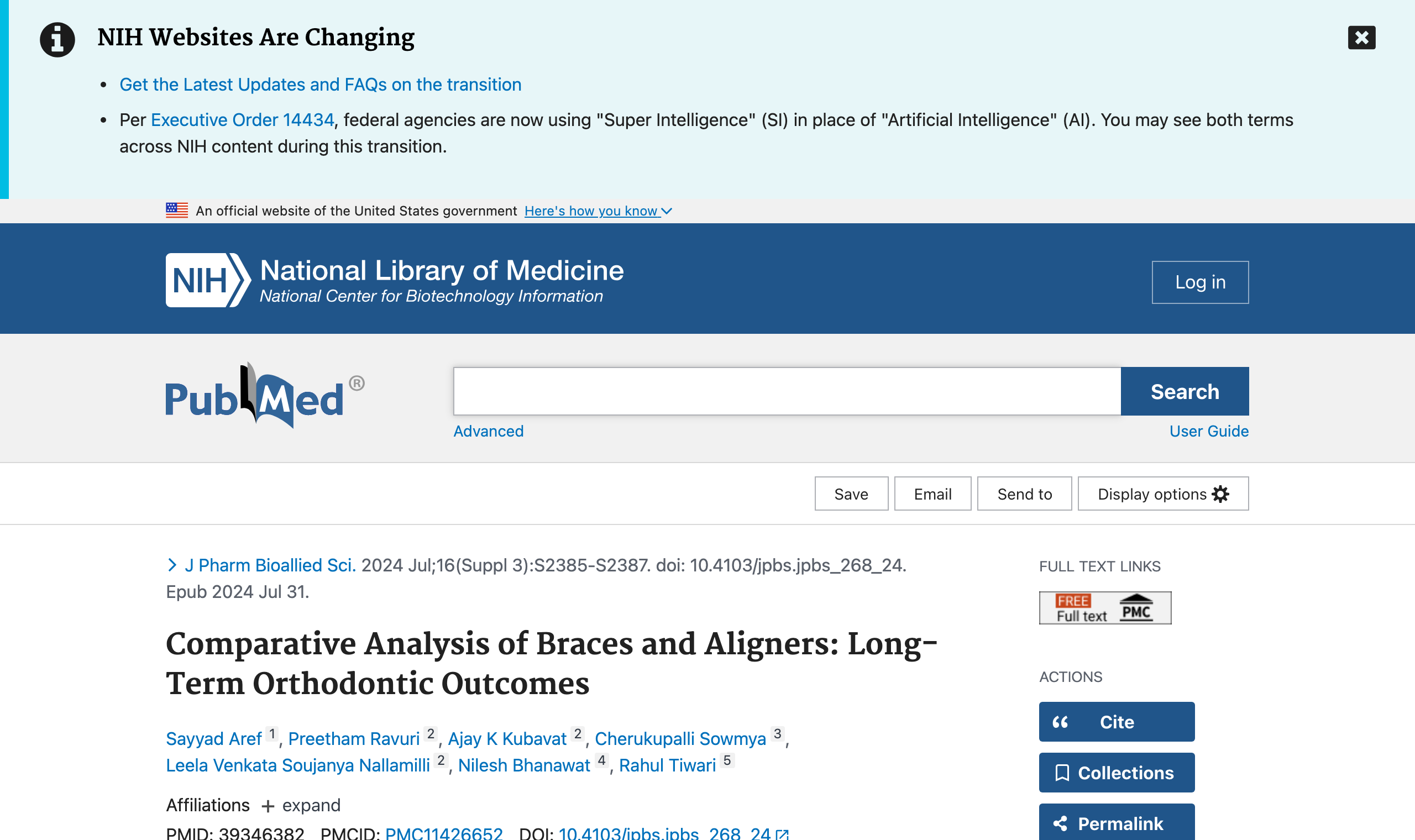
Source: Aref et al., Journal of Pharmacy and Bioallied Sciences, 2024 (PubMed), screenshot taken 24 November 2026.
How ClinicCode Builds Compliant Cosmetic Dentistry Websites
ClinicCode builds AHPRA-compliant websites for Australian cosmetic clinics and dental practices. Every cosmetic clinic and dental website we build starts from the current advertising guidelines, so an Invisalign pricing page or case study can be specific without becoming a liability.
For practices that want the fixes, the compliant rebuild and ongoing compliant ad management as one service, ClinicCode’s compliance fixes and compliant rebuild is built specifically for regulated dental and cosmetic clinics.
Data sources: Orthodontics Australia, “How much do braces cost?” (16 June 2025); Aref S et al., Journal of Pharmacy and Bioallied Sciences (2024); Ahpra, Advertising guidelines.
ClinicCode builds AHPRA-compliant websites for Australian cosmetic clinics and dental practices. Contact us to discuss a compliant rebuild.
Vikas Thakur
Founder, Perth. 16 years of experience from working at TPG, iiNet and Monadelphous, now helping Australian clinics keep their websites, ads and online presence AHPRA compliant.