TGA Infringement Notice for Prescription Ads: $21,840
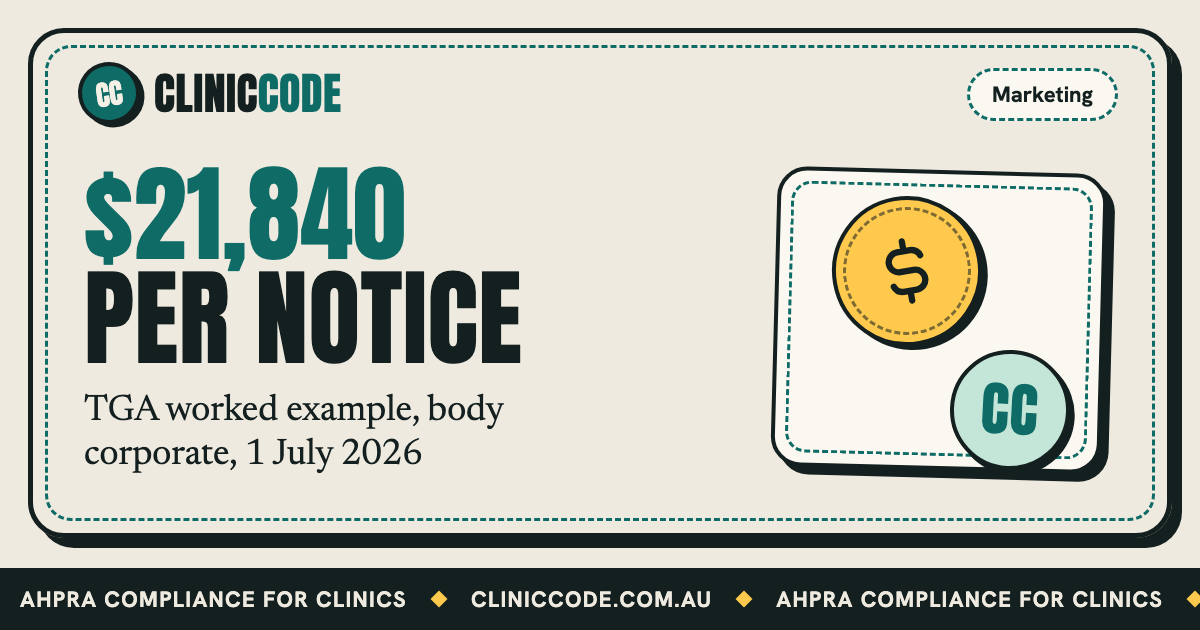
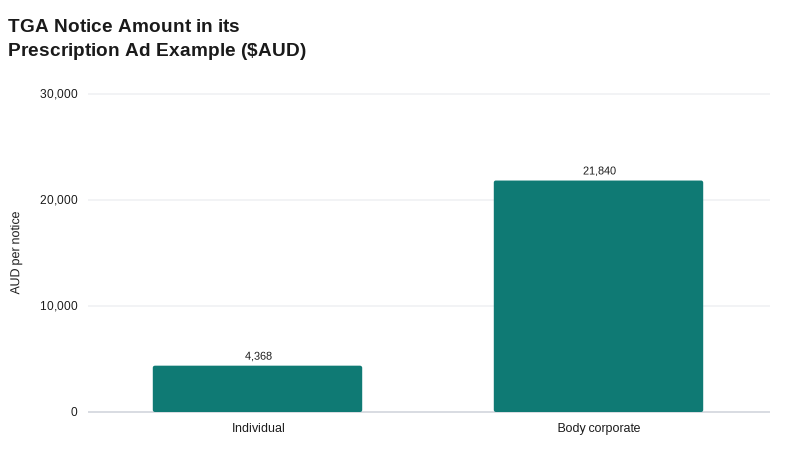
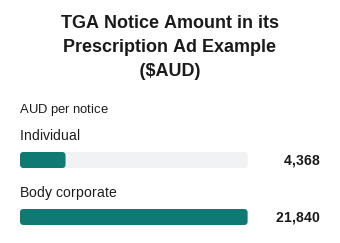
The TGA’s worked example puts an infringement notice for advertising a prescription-only medicine at $21,840 for a body corporate and $4,368 for an individual. It is a formula amount, not a cap: the TGA can issue one notice per alleged breach.
 Vikas Thakur Founder, Perth Updated Nov 24, 2026 10 min read Fact checked
Key takeaways
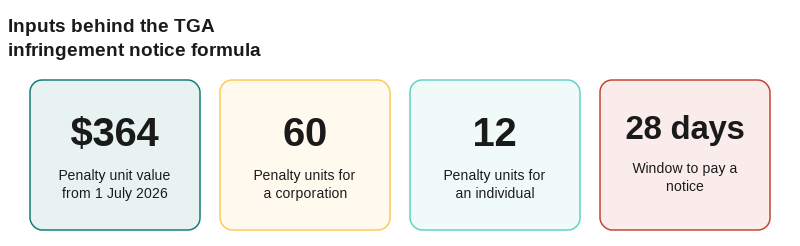
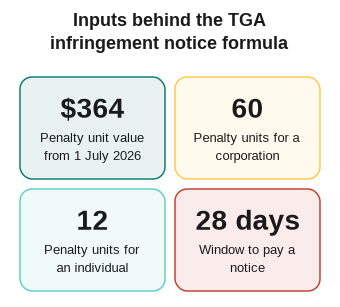
- The TGA’s infringement notice amount for advertising a prescription-only medicine to consumers works out to $21,840 for a body corporate and $4,368 for an individual, using the penalty unit value of $364 as at 1 July 2026 (TGA)
- The amount is 60 penalty units for a corporation and 12 for an individual, multiplied by $364, per the TGA’s worked example
- This is not the court-ordered penalty track Ahpra describes, where a court may order up to $60,000 per offence for an individual and $120,000 per offence for a body corporate (Ahpra). An infringement notice is an administrative fine the TGA can issue as an alternative to court action
- A recipient has 28 days to pay, and the TGA says payment is not an admission of liability
- The TGA can issue an infringement notice for each alleged breach, and its guidance says an advertising breach over multiple days may be treated as individual contraventions, i.e. per day
- The TGA’s worked example uses section 42DLB of the Therapeutic Goods Act: advertising a prescription-only medicine to consumers
- The TGA’s public infringement notice register lists notices for alleged unlawful advertising under section 42DLB(1) of the Act involving Switch Nutrition Pty Ltd and Prime Medic Group Pty Ltd, both marked as paid (TGA register)
- If a notice isn’t paid, the TGA says it will usually take the recipient to court, by referral to the Commonwealth Director of Public Prosecutions for criminal prosecution or by starting civil penalty proceedings
According to the TGA’s infringement notice guidance, a notice for advertising a prescription-only medicine to consumers works out to $21,840 for a body corporate and $4,368 for an individual, using a penalty unit value of $364 as at 1 July 2026. Unlike the court-ordered penalties Ahpra describes, this is a separate, faster mechanism the TGA can use as an alternative to court action.
This is an administrative fine, not the court-ordered penalty track Ahpra describes. It is calculated straight off a formula in the Act. The TGA’s own published example for that formula uses advertising a prescription-only medicine to consumers. Below is what the formula says, how the number is calculated, and the one detail in the TGA’s guidance that can turn a single non-compliant page into a stack of separate notices.
How the TGA calculates the notice amount
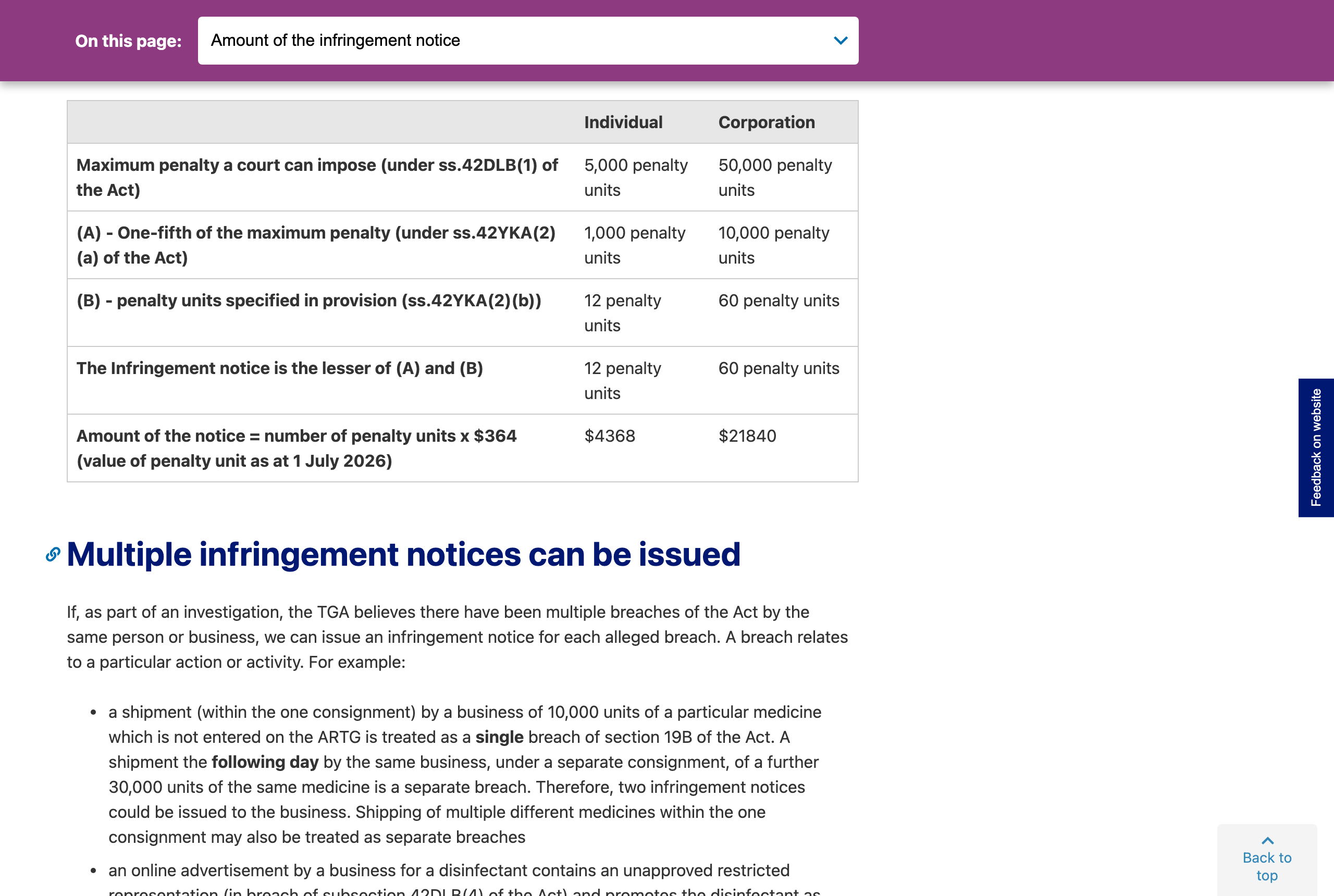
The TGA doesn’t get to pick a number. Under subsection 42YKA(3) of the Therapeutic Goods Act 1989, the TGA must use a formula and says it has no discretion to set a higher value, even if it thinks a specific breach warrants more. The formula relies on the value of a penalty unit under the Crimes Act 1914, which the TGA lists as $364 as at 1 July 2026 (TGA).
For an advertising breach under section 42DLB(1), such as advertising a prescription-only medicine to consumers, the TGA’s own worked example lays out the maths in full. The TGA’s table gives a court maximum of 5,000 penalty units for an individual and 50,000 for a corporation. The notice is the lesser of one-fifth of that maximum or the penalty units specified in the provision, which comes to 12 penalty units for an individual and 60 for a corporation. Multiply by $364 and you land on $4,368 and $21,840.
| Step | Individual | Corporation |
|---|---|---|
| Maximum penalty a court can impose (s.42DLB(1)) | 5,000 penalty units | 50,000 penalty units |
| One-fifth of the maximum (s.42YKA(2)(a)) | 1,000 penalty units | 10,000 penalty units |
| Fixed figure specified in the Act (s.42YKA(2)(b)) | 12 penalty units | 60 penalty units |
| Infringement notice amount (lesser of the two rows above) | 12 penalty units | 60 penalty units |
| Dollar value at $364 per unit (1 July 2026) | $4,368 | $21,840 |
Source: TGA, Information about infringement notices (last updated 3 July 2026).
Takeaway: The $21,840 figure isn’t a headline number pulled from a press release. It’s the direct output of a statutory formula, and the TGA’s own example is advertising a prescription-only medicine to consumers.
Two different penalty tracks, easy to confuse
Ahpra says that where an advertiser breaches the National Law, the matter may be prosecuted and a court may order a penalty of up to $60,000 per offence for an individual or $120,000 per offence for a body corporate (Ahpra, Advertising and the law). That is the bigger number on paper. But it is a different regulator, running a different process, under different legislation.
The TGA’s infringement notice sits alongside that, as a faster compliance tool. The TGA says it uses notices generally where there is a reasonable prospect they will achieve compliance quickly, as an alternative to court action. The recipient has 28 days to pay, can request an extension, or can ask for the notice to be withdrawn. Paying discharges the liability and isn’t an admission of liability, but the TGA also says paying without fixing the non-compliant activity may lead to escalating compliance action.
| TGA infringement notice | Ahpra advertising penalty (court-ordered) | |
|---|---|---|
| Regulator | Therapeutic Goods Administration | Ahpra and the National Boards |
| Body corporate | $21,840 per notice (the TGA’s worked example for advertising a prescription-only medicine) | Up to $120,000 per offence (court maximum) |
| Individual | $4,368 per notice (same worked example) | Up to $60,000 per offence (court maximum) |
| Process | Administrative notice, an alternative to court action | Prosecution, with a court ordering any penalty |
| Payment window | 28 days | Not applicable |
Source: TGA, Information about infringement notices; Ahpra, Advertising and the law.
Takeaway: A TGA notice in the worked example is a smaller figure than Ahpra’s per-offence court maximum, but it is not the TGA’s ceiling. For the same breach (section 42DLB(1)) the TGA’s own table gives a court maximum of 50,000 penalty units for a corporation, about $18.2 million at $364 a unit (our arithmetic). A clinic could face either regulator, or both, from the same piece of non-compliant copy.
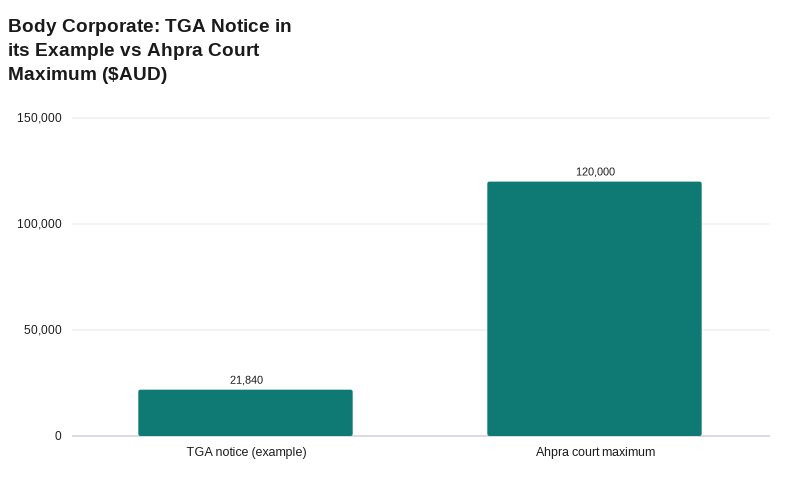
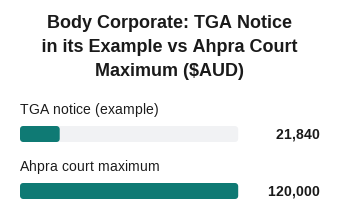
Source: TGA; Ahpra. TGA figure is the per-notice amount in the TGA’s prescription-only advertising example; Ahpra figure is the court maximum per offence. It is not the TGA’s maximum for the same breach, which is 50,000 penalty units for a corporation under the table in the TGA’s guidance.
Why a website is the easiest place to trigger one
The TGA’s own worked example for the $21,840 and $4,368 figures is built on section 42DLB: advertising a prescription-only medicine to consumers. A clinic’s treatment pages, ad copy and booking widget are public advertising surfaces, so any prescription-only treatment named on them is worth checking against that provision (this is our reading, not a statement the TGA makes about clinics).
The detail that changes the maths sits in the TGA’s guidance on multiple notices. A breach relates to a particular action or activity, and the TGA’s examples include an online advertisement for a disinfectant, where it says an advertising breach “over multiple days may also be treated as individual contraventions i.e. per day”. By contrast, it says a single breach in a hard copy magazine would be treated as a single contravention (TGA). The same sentence live on a website for a week is a different question, and the TGA’s guidance leaves that door open. The TGA also says it is not always appropriate to issue a notice for every alleged breach and that multiple notices may not be proportionate.
This is exactly the kind of gap that needs fixing before a regulator finds it (book a call): implied TGA approval, restricted representations, testimonials, or prescription-only treatment claims sitting on a page nobody has reviewed since launch.
Takeaway: The TGA’s worked example is about advertising a prescription-only medicine to consumers, and a website is an advertising surface that can stay live for a long time without anyone checking it.
What a stack of notices could look like
This isn’t theoretical enforcement. The TGA’s infringement notice register lists notices for alleged unlawful advertising under section 42DLB(1) of the Act involving Switch Nutrition Pty Ltd and Prime Medic Group Pty Ltd, both with the status “Infringement notice paid”. The register describes the Prime Medic matter as alleged unlawful advertising of weight loss medicines.
Here’s the part worth sitting with. Take the TGA’s “per day” note and run it forward as our own arithmetic, not as a claim about any specific case: 21,840 (the TGA’s body corporate amount in its prescription-only advertising example) multiplied by the number of days. One day is $21,840, three days is $65,520 and five days is $109,200. Whether the TGA would treat a given page this way is its call to make, and it says multiple notices may not always be proportionate. What the TGA has said, in its published guidance, is that the option exists.
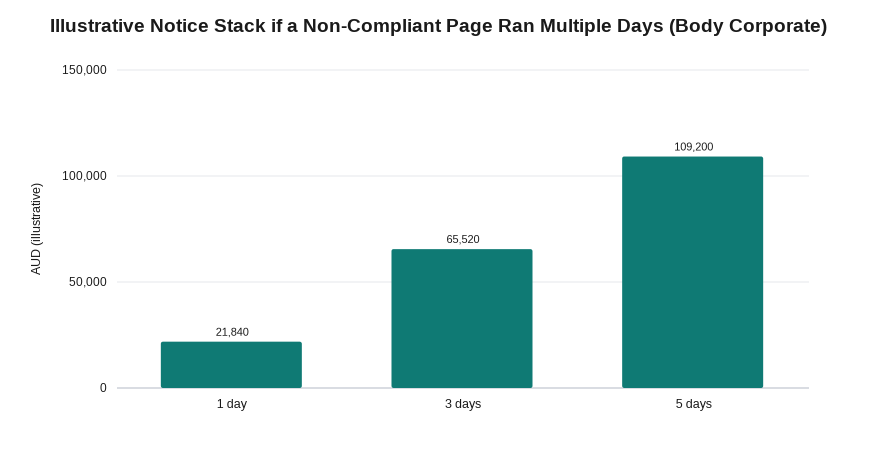
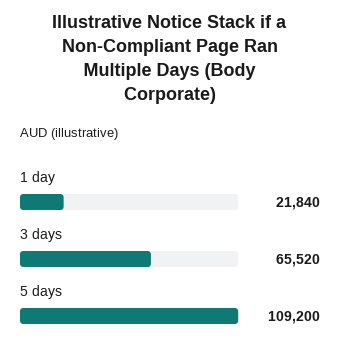
Source: our arithmetic, 21,840 multiplied by 1, 3 and 5 days, using the per-notice amount in TGA’s guidance. Illustrative only.
Takeaway: The TGA’s guidance leaves open counting an online advertisement per day, so the days a page stayed up can matter.
What to check on your site before the next rebuild
A website review is far cheaper than finding out the hard way. Three checks worth running today, in order of how quickly a regulator or a competitor would spot them:
- Implied TGA approval or endorsement. Any wording that suggests a treatment or product has been approved, cleared or endorsed by the TGA specifically, rather than simply being lawfully supplied.
- Prescription-only treatments named without the right context. Anti-wrinkle injections, prescription-only dermal fillers and similar treatments may fall inside the same advertising provision the TGA’s example is built on.
- Pages nobody has reviewed since launch. The TGA’s per-day note suggests an old, forgotten page could carry more exposure than a new one, simply because it has had longer to accumulate potential breach days.
ClinicCode builds and fixes cosmetic clinic websites specifically against this kind of enforcement gap, not as generic web design, but as a compliance-first build process that treats every treatment page as a piece of regulated advertising, because that’s how the advertising rules treat it.
Takeaway: The cheapest fix here is a website review before a regulator tests your own pages.
Frequently asked questions
Is $21,840 the maximum a clinic could be fined overall? No. It’s the amount in the TGA’s worked example for a single infringement notice. The TGA can issue a separate notice for each alleged breach, and its guidance says an advertising breach over multiple days may be treated as individual contraventions, i.e. per day.
Does paying an infringement notice mean the clinic admitted wrongdoing? No. The TGA says paying discharges the recipient’s liability and is not an admission of liability. It also isn’t a fix for the underlying non-compliant advertising, and the TGA says paying without addressing it may lead to escalating compliance action.
Is this the same as AHPRA’s $120,000 penalty? No. They’re different regulators running different processes. Ahpra describes court-ordered penalties of up to $60,000 per offence for an individual and $120,000 per offence for a body corporate. See Ahpra’s advertising penalties for that separate mechanism.
Get Your Advertising Checked Before It’s Tested
Ready to see what a regulator would find on your own site? Book a compliance-focused website review before a regulator tests a page nobody has checked in months.
Sources and References
- Therapeutic Goods Administration, “Information about infringement notices.” Last updated 3 July 2026. tga.gov.au. Date checked: 24 November 2026. Source for the penalty unit value of $364 as at 1 July 2026, the 12 and 60 penalty unit calculation, the $4,368 and $21,840 amounts, the section 42DLB example, the 28-day payment window, payment not being an admission of liability, and the multiple-notice and per-day guidance.
- Therapeutic Goods Administration, “Infringement notices” (public register). tga.gov.au. Date checked: 24 November 2026. Source for the register entries under section 42DLB(1) naming Switch Nutrition Pty Ltd and Prime Medic Group Pty Ltd.
- Ahpra, “Advertising and the law.” ahpra.gov.au. Date checked: 24 November 2026. Source for the $60,000 per offence (individual) and $120,000 per offence (body corporate) maximum penalties.
Vikas Thakur
Founder, Perth. 16 years of experience from working at TPG, iiNet and Monadelphous, now helping Australian clinics keep their websites, ads and online presence AHPRA compliant.