95.5% of Porcelain Veneers Survive 10 Years, Study Finds
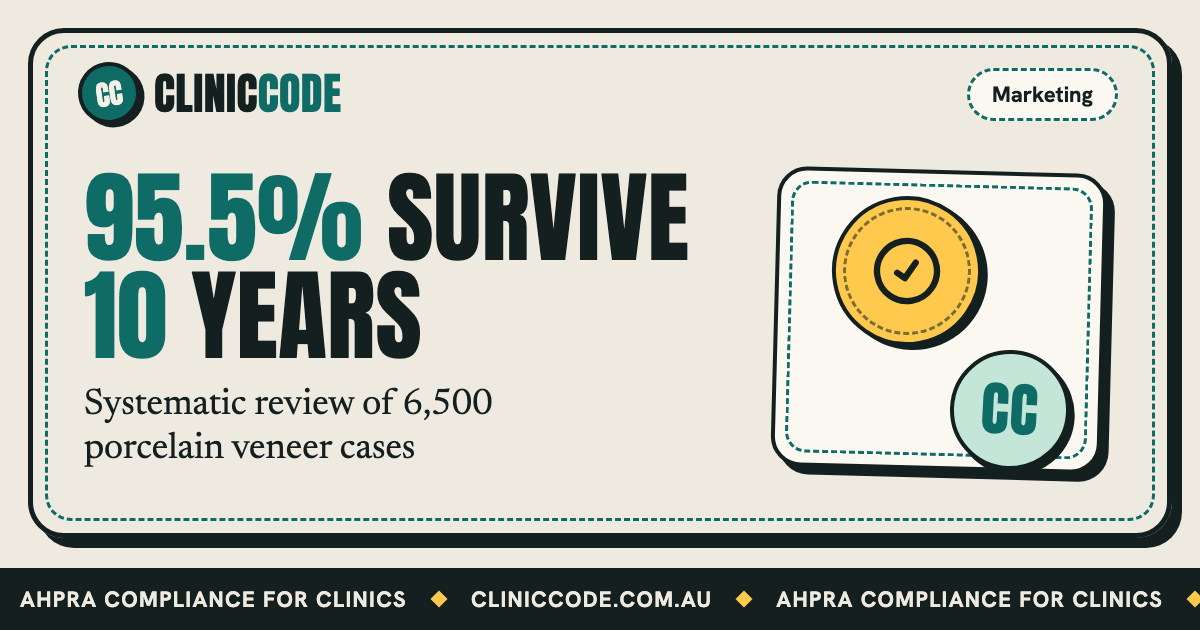
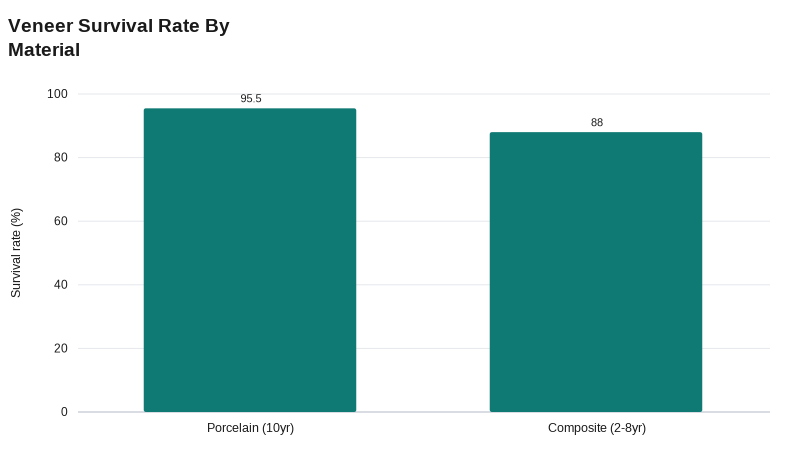
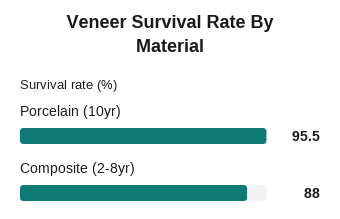
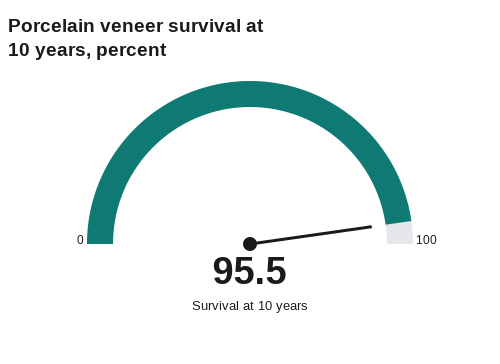
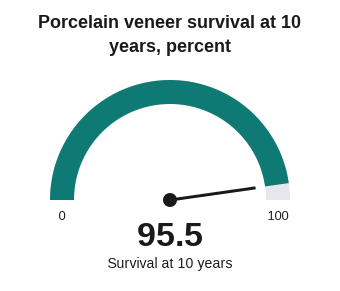
A 2021 systematic review of 25 studies and 6,500 porcelain veneers found a 95.5% survival rate at 10 years. A separate 2023 review of 7 composite veneer studies found an 88% pooled survival rate specific to its 3 randomised controlled trials, over 2 to 8 years. Here is what the clinical research actually shows, and what it means for a dental practice website.
 Vikas Thakur Founder, Perth 9 min read Fact checked
Key takeaways
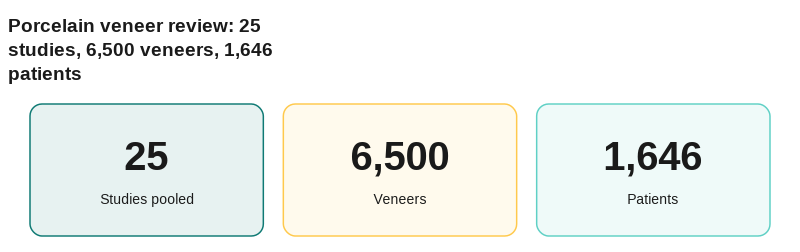
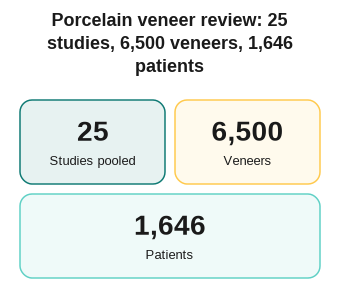
- Porcelain veneers had a 95.5% survival rate at 10 years, based on a 2021 systematic review of 25 studies and 6,500 veneers across 1,646 patients
- Composite veneers had an 88% pooled survival rate (95% CI: 81% to 94%) for the 3 randomised controlled trials in a 2023 review of 7 studies, over a mean follow-up of 24 to 97 months
- Fracture was the most common cause of porcelain veneer failure. Isolating fracture as the sole cause counted, the 10-year survival rate was 96.3%
- Debonding, secondary caries and the need for root canal treatment each had isolated 10-year survival rates of 99% or higher for porcelain veneers
- AHPRA’s guidelines for advertising cosmetic procedures, in effect since 2 September 2025, now require a warning that results may vary for other patients in advertisements that use images
- We found no Australian dataset from AHPRA, the ADA, AIHW or the ABS that reports a veneer-specific survival figure. The numbers above come from international clinical literature
- The gap between porcelain’s 10-year proof point and composite’s 2-to-8-year proof point is a follow-up-duration gap in the research, not proof that composite fails sooner in every case
Porcelain veneers had a 95.5% survival rate at 10 years, according to a 2021 systematic review covering 25 studies, 6,500 veneers and 1,646 patients. That is a specific, sourced figure, not a loose range. Composite veneers, the cheaper resin alternative, pooled at an 88% survival rate across the randomised controlled trials in a 2023 review of 7 studies, though the longest tracked follow-up in that dataset runs to just over 8 years. This article works through both figures, where they come from, and why the biggest single risk to a porcelain veneer is mechanical, fracture, not staining or gum health. It closes with what the data means for how a dental practice website should present lifespan information under AHPRA’s current advertising rules.
The Real Survival Data: Porcelain vs Composite
| Material | Survival Rate | Follow-Up Period | Studies Behind the Figure | Source |
|---|---|---|---|---|
| Porcelain | 95.5% | 10 years | 25 studies, 6,500 veneers, 1,646 patients | Alenezi et al. 2021 |
| Composite | 88% (95% CI 81-94%), RCTs only | 24 to 97 months (about 2 to 8 years) | 7 studies (3 RCTs, 4 cohort studies) | Lim et al. 2023 |
Porcelain veneers are lab-fabricated ceramic shells bonded onto the tooth. The clinical literature has tracked them long enough to produce a genuine 10-year figure: 95.5%, from a systematic review in the Journal of Clinical Medicine that pooled 25 separate studies. Composite veneers are resin built up directly on the tooth in a single visit, and the research base behind them is thinner. The 2023 review behind the 88% figure covered 7 eligible studies, but the 88% pooled survival rate applies specifically to its 3 randomised controlled trials, with follow-up ranging from 24 to 97 months, so it describes a shorter, less consistent tracking window than the porcelain figure.
Source: Alenezi et al. 2021, Journal of Clinical Medicine.
Source: Alenezi et al. 2021 (porcelain, 10 years); Lim et al. 2023 (composite, randomised controlled trials only, 24 to 97 months). The two figures cover different follow-up windows.
Takeaway: Porcelain’s 95.5% figure and composite’s 88% figure are not measuring the same thing. One tracks 10 years, the other tracks a shorter and more variable window, so the honest comparison is proof-point strength, not a straight percentage-versus-percentage read.
Why a 95.5% Survival Rate Still Means Some Veneers Fail
A 95.5% estimated cumulative survival rate at 10 years means the remaining 4.5% had failed by that point, as the review defined failure. The 2021 review breaks down what causes those failures, and the answer is mechanical, not cosmetic. Fracture was the most common single cause. Isolating fracture as the only cause under consideration lifted the 10-year rate to 96.3%, so fracture is the largest single contributor to that overall failure rate. Debonding, secondary caries under the veneer margin, and the later need for root canal treatment were each far rarer, with isolated 10-year survival rates of 99% or higher for all three.
Source: Alenezi et al. 2021.
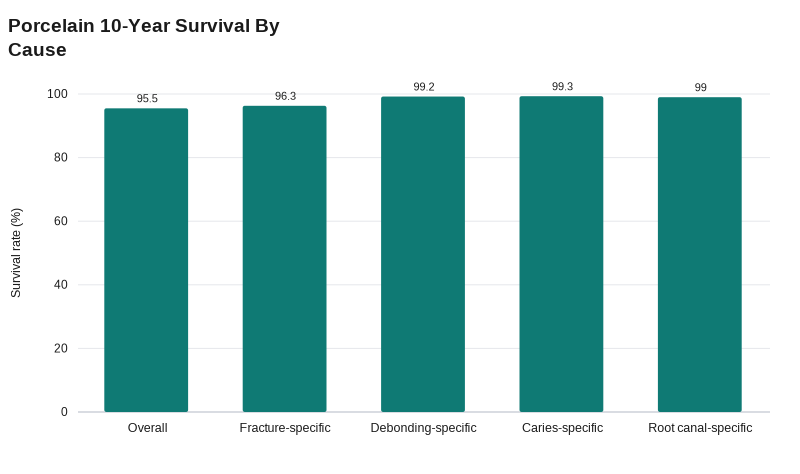
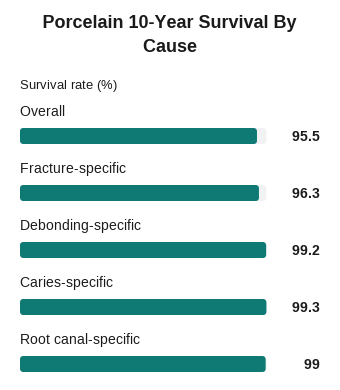
Source: Alenezi et al. 2021. Each bar is the 10-year survival rate with that single cause counted as the only reason for failure.
Takeaway: If a porcelain veneer fails within 10 years, fracture is the most likely reason, not decay or gum problems, which points toward bite force and grinding habits as the more relevant risk factor than oral hygiene alone.
No Australian Dataset Exists, and That Gap Matters
We looked for an Australian-specific figure before relying on the international research above, and we found no AHPRA, ADA, AIHW or ABS dataset that reports veneer survival. AHPRA regulates practitioner conduct and advertising rather than clinical outcomes. Unless a practice can point to a specific study, a “how long do veneers last” claim most likely restates international clinical literature, as the figures here do.
Takeaway: Treat any Australian-specific veneer lifespan claim with the same scepticism the research itself deserves, and ask which study it rests on.
What AHPRA’s Rules Mean for Publishing Lifespan Claims
AHPRA’s guidelines for advertising cosmetic procedures took effect on 2 September 2025. AHPRA’s own announcement lists three changes to advertising directly relevant to content built around outcome data: advertisements must use only real, unedited images, advertisements using images must carry a warning that results may vary for other patients, and the ban on testimonials was strengthened for social media influencers.
None of that bans a practice from publishing research-sourced educational content, such as a page explaining what the clinical literature says about veneer lifespan. That is a different content category to a personal patient outcome claim or a before/after gallery. Where the line sits for a specific page, image or ad account is a practice-by-practice question, not something a general article can answer. Our full breakdown of AHPRA’s advertising rules for cosmetic dentistry covers what applies to veneer marketing specifically, including before/after imagery, brand naming and outcome language.
Takeaway: Citing a published survival-rate study by name is a materially different content type to a testimonial or a before/after photo, but the current rules are specific enough that a practice’s actual content should be checked against them directly, not inferred from a general article.
What This Means for Your Practice Website and Booking Flow
A patient searching “how long do veneers last” is not close to booking yet. They are comparing materials, and a page that answers with a specific, sourced figure, rather than a rounded claim like “veneers that last a lifetime”, reads as more credible. It also sets an expectation the practice can stand behind later, since an unqualified lifespan promise is the kind of claim that turns into a complaint once a veneer fails inside the promised window.
The same logic applies to the booking flow. A consultation page that lets a prospective patient see the porcelain-versus-composite trade-off, sourced and specific, before they book a first appointment should produce a better-informed enquiry than a page that skips straight to a “book now” button with no context. ClinicCode builds cosmetic clinic and dental practice websites around exactly this kind of sourced, compliant content, structured so the research sits clearly apart from any advertising claim.
Takeaway: A lifespan page built on cited research, not a rounded sales claim, does double duty: it is more useful to a patient still comparing materials, and it is a safer content category under the current advertising rules than an outcome claim would be.
FAQ
How long do porcelain veneers actually last, based on clinical research?
A 2021 systematic review of 25 studies and 6,500 porcelain veneers found a 10-year survival rate of 95.5%. Fracture was the most common cause of failure. When fracture was isolated as the sole cause counted (other complications set aside), the 10-year survival rate was 96.3%. The review is Alenezi, Alsweed, Alsidrani and Chrcanovic, published in the Journal of Clinical Medicine.
How long do composite veneers last compared to porcelain?
A 2023 systematic review covering 7 composite veneer studies (3 randomised controlled trials and 4 cohort studies) reported an 88% pooled survival rate (95% CI: 81% to 94%) specifically for the 3 randomised controlled trials, over a mean follow-up of 24 to 97 months, roughly 2 to 8 years. That is a shorter proven follow-up window than porcelain’s 10-year figure. The source is Lim, Tan, Li and Burrow, Journal of Evidence-Based Dental Practice.
Does an Australian dataset on veneer lifespan exist?
We found no AHPRA, ADA, AIHW or ABS dataset that reports veneer survival rates specifically. The figures in this article come from international systematic reviews and meta-analyses of clinical studies, not an Australian-specific data source.
Can a dental practice publish veneer lifespan data on its website under AHPRA’s advertising rules?
AHPRA’s guidelines for advertising cosmetic procedures, in effect since 2 September 2025, restrict testimonials, before/after imagery and unqualified outcome claims, and require a warning that results may vary for other patients in advertisements that use images. General research-sourced information, such as citing a published survival rate study, sits in a different content category to a personal patient outcome claim. See our full breakdown of AHPRA’s advertising rules for cosmetic dentistry for what a practice website can and cannot publish.
Get an AHPRA Compliance Check on Your Practice Website
ClinicCode fixes cosmetic dental practice websites and ad accounts against the current AHPRA advertising rules.
Call me backSources and References
Alenezi, Alsweed, Alsidrani & Chrcanovic, Journal of Clinical Medicine (2021) - “Long-Term Survival and Complication Rates of Porcelain Laminate Veneers in Clinical Studies: A Systematic Review”: 25 studies, 6,500 veneers, 1,646 patients, 95.5% 10-year survival rate and the fracture/debonding/caries/root canal breakdown
Lim, Tan, Li & Burrow, Journal of Evidence-Based Dental Practice (2023) - “Survival and complication rates of resin composite laminate veneers: A systematic review and meta-analysis”: 7 studies (3 RCTs, 4 cohort studies), 88% pooled survival rate (95% CI 81-94%) specific to the 3 RCTs, 24-to-97-month follow-up range
AHPRA - “Putting patients first: New guidelines for cosmetic procedures,” confirming the 2 September 2025 effective date and the requirement that advertised results carry a warning that results may vary between patients
AHPRA Advertising Rules for Cosmetic Dentistry Australia: full breakdown of what a dental practice can and cannot publish about veneers and other cosmetic dental treatments
Related reading:
- Porcelain vs Composite Veneers: Cost & Lifespan Data: the cost side of the material trade-off
- Veneers Cost Australia: State-by-State Price Data: published per-tooth pricing by city
- Clinic Website Design: compliant website builds for AHPRA-regulated dental practices
For a practice website and booking flow built around sourced, compliant content, talk to us about your practice’s website.
Vikas Thakur
Founder, Perth. 16 years of experience from working at TPG, iiNet and Monadelphous, now helping Australian clinics keep their websites, ads and online presence AHPRA compliant.