Clinic Website Speed: What Slow Pages Cost in Lost Enquiries
We found no published Australian benchmark for cosmetic clinic website speed. This is the closest global research on slow pages and lost enquiries.
 Vikas Thakur Founder, Perth 8 min read Fact checked
Key takeaways
- We found no published Australian benchmark for cosmetic clinic website speed specifically
- Globally, 59% of mobile pages achieved a good Largest Contentful Paint score in 2024, per HTTP Archive’s 2024 Web Almanac
- Portent’s analysis of just over 100 million page views found the average goal conversion rate was almost 40% at a 1-second load time and 29% from 3 seconds, per Portent
- Google/SOASTA research from 2017 found the probability of a bounce rises 90% as mobile load time goes from 1 to 5 seconds, cited in Deloitte Digital’s Milliseconds Make Millions report
We found no government body or industry group that publishes an Australian benchmark for cosmetic clinic website speed specifically. What exists is global research, and it points one way: slower pages lose visitors before they convert. A slow page loses enquiries before a prospective patient reads a single word about a treatment. This article sets out what the closest verified research says a heavy, slow clinic homepage costs in bounce rate and enquiry conversion, and what to check on your own site.
What We Looked For, and Why No Australian Benchmark Turned Up
We looked for an existing Australian dataset that benchmarks cosmetic clinic website speed specifically and found none. The ABS, AIHW and IBISWorld publish data on health and cosmetic procedure industries, not on the websites clinics use to book patients, as far as we could find. HTTP Archive’s Web Almanac publishes global Core Web Vitals data. Google’s PageSpeed Insights reports one site at a time, not an aggregate.
Page weight is one thing you can check yourself. The HTML document is the one resource every visitor’s browser must download and parse before anything else on the page can start. Images, fonts, scripts and booking widgets then load on top of it. A heavy page is usually carrying unminified code, inline styles, or tracking and chat scripts stacked directly into the page rather than loaded efficiently. None of that is visible to a patient scrolling the page. All of it delays the moment the page becomes usable.
Takeaway: We found no cosmetic-clinic-specific website speed benchmark for Australia, so the closest evidence is global research, set out below.
What the Global Research Shows About Speed and Lost Enquiries
No Australian study we found links clinic website speed to enquiry volume directly. The closest verified evidence is global. HTTP Archive’s 2024 Web Almanac, built from real Chrome user data, reports that “In 2024, 59% of mobile pages achieved a good LCP score.” LCP is Largest Contentful Paint, the point at which a page’s main content becomes visible to the visitor, and Google’s “good” threshold is under 2.5 seconds. The same chapter reports 74% of mobile websites had a good Interaction to Next Paint (INP) score and 79% of mobile sites had a good Cumulative Layout Shift (CLS) score.
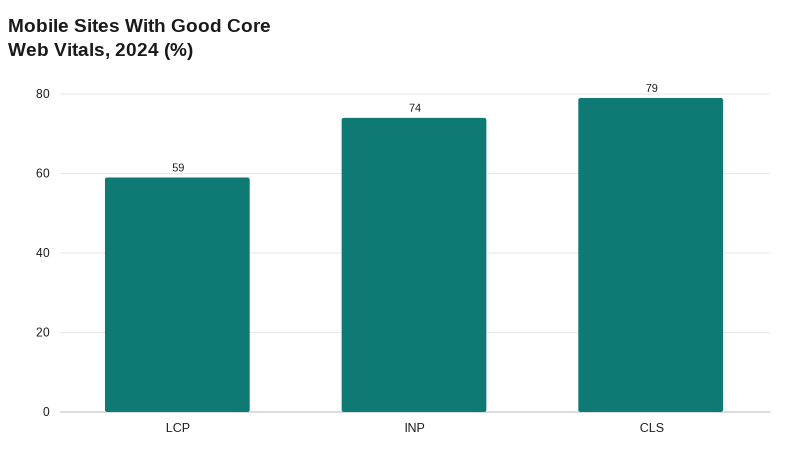
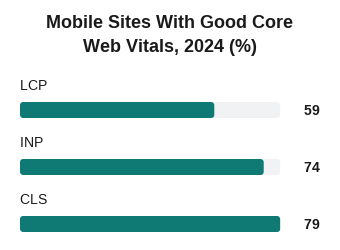
Source: HTTP Archive, 2024 Web Almanac, Performance chapter, mobile results worldwide (LCP: Largest Contentful Paint, INP: Interaction to Next Paint, CLS: Cumulative Layout Shift).
On the conversion side, Portent’s April 2022 analysis looked at just over 100 million page views across 20 B2B and B2C sites. For goal conversions, such as a simple exchange of contact information, it reports: “When pages load in 1 second, the average conversion rate is almost 40%. At a 2-second load time, the conversion rate already drops to 34%. At 3 seconds, the conversion rate begins to level off at 29% and reaches its lowest at a 6-second load time.” The data is global and mixes site types, so treat it as a direction, not a clinic forecast.
Deloitte Digital’s Milliseconds Make Millions study analysed mobile site data from 37 retail, travel, luxury and lead generation brands across Europe and the US. It found a 0.1-second mobile speed improvement was associated with an 8.4% increase in conversions for retail and a 10.1% increase for travel. Those are retail and travel results, not clinic results. The same report cites Google/SOASTA 2017 research on how the probability of a bounce increases as mobile load time grows.
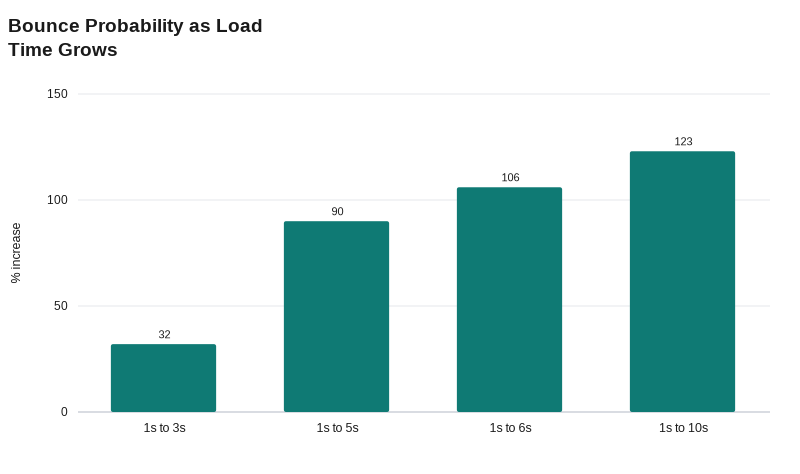
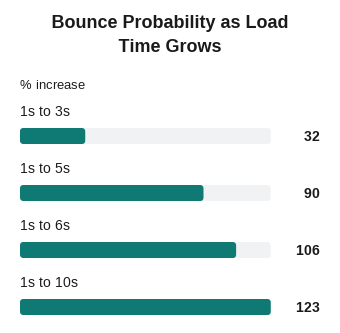
Source: Deloitte Digital, Milliseconds Make Millions, citing Google/SOASTA research 2017: the probability of bounce increases as mobile page load time goes from 1s to 3s, 5s, 6s and 10s.
Takeaway: None of this research is Australian or clinic-specific, but the direction is the same across every dataset we found: slower pages lose visitors before they convert.
What This Means for Your Clinic’s Landing Pages
A heavy homepage is rarely one big mistake. It is usually a stack of small ones: an oversized script here, an unminified stylesheet there, a tracking pixel nobody has audited since the site launched. Fixing that is a technical job, and it is a separate job from writing AHPRA-compliant copy about a treatment.
The two do intersect on one point worth acting on. If a treatment gets its own dedicated landing page instead of a paragraph buried on a general services page, that page has less competing content on one document, targets a more specific enquiry, and gives you a single page to audit for advertising compliance rather than an entire site. A patient searching for one specific treatment, on a fast page built for exactly that search, is a better-qualified enquiry than one who bounced off a slow homepage before finding what they were looking for.
What a clinic is allowed to say about a treatment on that page, including rules around testimonials and result claims, is a separate question from page speed, and one worth checking against the current advertising guidelines rather than assuming. ClinicCode reviews both together: what your pages say, and how fast they deliver it. For clinics rebuilding a slow site from the ground up, see our work on cosmetic clinic websites built for AHPRA-regulated practices from the first line of code.
Takeaway: Speed and compliance are different problems that show up on the same page, and a slow site with perfect copy still loses the enquiry before the copy gets read.
FAQ
Is there an official Australian benchmark for cosmetic clinic website speed?
We found no government body, industry association or published dataset that benchmarks Australian cosmetic clinic website speed specifically. The closest available context comes from global web performance research, such as HTTP Archive’s Web Almanac, set out in this article.
Does page weight affect how fast a clinic website loads?
In general, a heavier page takes longer to download and parse before a browser can finish requesting images, fonts and scripts. That is how web loading works, not a finding from our sources, and none of the sources we cite measures page weight, so we cannot give you a page-weight number. What they do measure is loading speed, and HTTP Archive’s 2024 Web Almanac found 59% of mobile pages achieved a good Largest Contentful Paint score, the metric that measures when a page’s main content becomes visible.
Does a slow clinic landing page reduce enquiry quality, not just enquiry volume?
The clearest evidence we found is Portent’s April 2022 analysis of just over 100 million page views across 20 B2B and B2C websites, which found the average goal conversion rate was almost 40% at a 1-second load time and 29% from 3 seconds, reaching its lowest at 6 seconds. That data is global, not Australia-specific or clinic-specific, but the mechanism, a slower page losing visitors before they finish an enquiry form, applies directly to a clinic’s treatment landing pages.
Get Your Clinic’s Website Speed and Compliance Checked Together
ClinicCode fixes cosmetic clinic websites for both build quality and AHPRA advertising compliance in one pass.
Talk to us about your clinic’s website
Sources and References
HTTP Archive, 2024 Web Almanac, Performance - global Core Web Vitals pass rates for Largest Contentful Paint, Interaction to Next Paint and Cumulative Layout Shift
Portent - goal conversion rate by page load time, drawn from just over 100 million page views across 20 B2B and B2C websites
Deloitte Digital, Milliseconds Make Millions - conversion lift from a 0.1 second mobile speed improvement across 37 brands, and Google/SOASTA 2017 bounce-probability research cited within it
Related reading:
- Clinic Website Design: compliant, fast website builds for AHPRA-regulated clinics
- Clinic Website Costs in Australia: What You Should Pay: what a properly built clinic website should cost to build and host
Vikas Thakur
Founder, Perth. 16 years of experience from working at TPG, iiNet and Monadelphous, now helping Australian clinics keep their websites, ads and online presence AHPRA compliant.