Cosmetic Injectable Laws by State Australia: Full Guide
From 5 November 2026 NSW applies new medicines laws to cosmetic injectables, with written directions valid for 6 months. Queensland and Victoria set very different possession penalties under their own Acts. Here is what each state’s rules say about Schedule 4 stock, penalties and licensing, with a source for each figure we quote.
 Vikas Thakur Founder, Perth 13 min read Fact checked
Key takeaways
- New South Wales moved to new medicines laws on 5 November 2026: the Medicines, Poisons and Therapeutic Goods Act 2022 and the Medicines, Poisons and Therapeutic Goods Regulation 2026 replaced the old Poisons and Therapeutic Goods Act and Regulation. NSW Health says written directions for cosmetic use substances are valid for 6 months (NSW Health, cosmetic use substances)
- NSW Health says the penalties under the new laws range from 20 to 400 penalty units for individuals and 100 to 2000 penalty units for corporations (NSW Health)
- Queensland’s Medicines and Poisons Act 2019, section 34, sets a maximum of 200 penalty units for buying or possessing an S4 or S8 medicine without authority (Act, current as at 23 September 2025). At the 1 July 2026 value of $172.70 per unit (QLS Proctor), our arithmetic puts that at $34,540
- Victoria’s Drugs, Poisons and Controlled Substances Act 1981, section 36B(2), sets 10 penalty units for possessing an S4 poison without authority (Act, Authorised Version 141). At $209.10 per unit from 1 July 2026 (Victorian Department of Treasury and Finance), our arithmetic puts that at $2,091
- One University of Sydney academic, Dr Christopher Rudge, wrote in September 2025 that prescriptions for cosmetic injectables are valid for 12 months in Victoria, Queensland and other states (University of Sydney). He did not list every state, so check yours
- NSW, Queensland, Victoria and Tasmania each publish guidance that names cosmetic injectables. We found no cosmetic-injectable-specific guidance from Western Australia, South Australia, the ACT or the Northern Territory, so clinics there apply the general medicines and poisons rules
Every state and territory in Australia regulates Schedule 4 cosmetic injectables under its own medicines and poisons law, and the penalties for getting it wrong are not consistent. Queensland’s maximum for unlawfully buying or possessing an S4 or S8 medicine is 200 penalty units. Victoria’s maximum for possessing an S4 poison without authority is 10 penalty units. NSW now runs a new regime with its own penalty ranges, set out in penalty units.
That is not a rounding difference. It is separate legal systems reaching different answers for holding the same vial of Botox.
This guide breaks down what each state’s rules actually say: which law governs, how long a prescription or direction stays valid, what licensing a clinic needs to hold Schedule 4 stock, and what the penalty regime looks like if that goes wrong. For who is legally allowed to hold the needle, doctor, dentist, nurse practitioner, or registered nurse under direction, see our companion piece on practitioner-type rules across the states. This one is about the laws themselves.
Schedule 4 Is a Federal Label. The Rules Around It Are Not
Botulinum toxin and deoxycholic acid are listed in Schedule 4 of the Commonwealth Poisons Standard, which classes them as prescription-only medicines, and several dermal filler ingredients are prescription-only when used in injectable preparations (Tasmanian Department of Health fact sheet). That part is uniform. What happens after that classification, who can buy the stock, how long a prescription stays valid, what a breach costs, is decided by each state and territory’s own law, and they do not agree. Dr Rudge makes the same point, describing “a confusing patchwork of state laws” (University of Sydney).
Ahpra’s guidelines for practitioners who perform non-surgical cosmetic procedures came into effect on 2 September 2025. They include a mandatory seven-day cooling-off period between the first consultation and any procedure for patients under 18, a total ban on advertising aimed at under 18s, a strengthened ban on testimonials from social media influencers, and a set period of practice that nurses must complete before expanding into non-surgical cosmetic procedures (Ahpra media release, 3 June 2025). None of that changes state possession law. Ahpra can act against a practitioner’s registration. It cannot tell a state health department how to interpret its own poisons Act.
| State/Territory | Governing law | Cosmetic-specific document? |
|---|---|---|
| New South Wales | Medicines, Poisons and Therapeutic Goods Act 2022 and Regulation 2026 | Yes, NSW Health cosmetic use substances page |
| Queensland | Medicines and Poisons Act 2019 | Yes, Queensland Health fact sheet, 15 April 2025 |
| Victoria | Drugs, Poisons and Controlled Substances Act 1981 | Yes, fact sheet for environmental health officers |
| Tasmania | Poisons Act and Poisons Regulations | Yes, cosmetic injectables fact sheet |
| Western Australia | Medicines and Poisons Act 2014 | None found |
| South Australia | Controlled Substances Act 1984 | None found |
| ACT | Not confirmed by us | None found |
| Northern Territory | Medicines, Poisons and Therapeutic Goods Act 2012 | None found |
Source: the linked pages in each row; WA, SA and NT governing laws per the WA Health licences page, the SA licence listing and the NT authorisation listing. “None found” means we found no such document, not that none exists.
Takeaway: Four jurisdictions have written something down about cosmetic injectables. A published fact sheet is not the same as a changed law.
New South Wales: New Laws From 5 November 2026
NSW Health says that from 5 November 2026 the Poisons and Therapeutic Goods Act and Regulation are replaced by the Medicines, Poisons and Therapeutic Goods Act 2022 and the Medicines, Poisons and Therapeutic Goods Regulation 2026 (NSW Health). 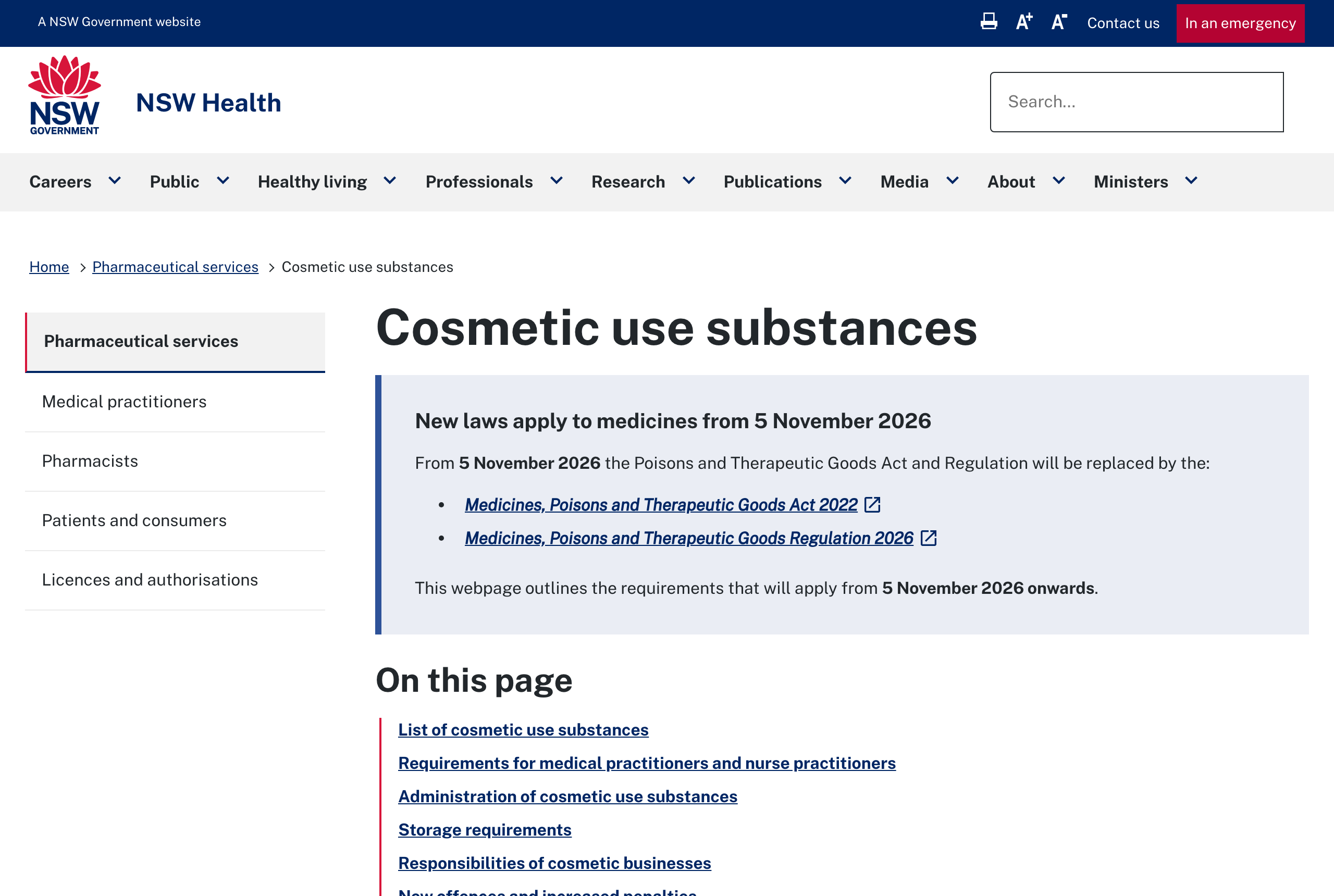
For cosmetic use substances, NSW Health states that the prescriber must personally review the patient in person or by video consultation before prescribing or giving a written direction, and that written directions are valid for 6 months and must be signed by the medical practitioner or nurse practitioner. A written direction must include the date of patient review and how long the direction applies for. Miss the 6-month window and the clinic needs a fresh review before treatment continues.
NSW Health says the penalties under the new laws range from 20 to 400 penalty units for individuals and 100 to 2000 penalty units for corporations, and that further information on compliance notices and penalties will be published later. We have not converted these into dollars, because we did not open the NSW penalty unit value from an official page.
Takeaway: NSW has a codified 6-month limit on how long a cosmetic written direction lasts, and its penalties are now set in penalty units under a new Act and Regulation.
Queensland: Exclusive Custody and a 200 Penalty Unit Ceiling
Queensland took a different path. Instead of writing new cosmetic-specific law, Queensland Health issued a fact sheet in December 2024 and revised it on 15 April 2025 after engagement with industry. The revised fact sheet states that there have been no changes to the relevant legislation since September 2021 (Queensland Health fact sheet). Its key messages: registered nurses are not authorised to buy S4 cosmetic injectable medicines, and only a doctor or nurse practitioner can buy them to hold as stock at a clinic where they exercise exclusive custody and control (or joint custody and control only with another doctor or nurse practitioner). Registered nurses may only possess S4 cosmetic injectables for purposes listed in the regulation, including administering a medicine on a prescription.
Medical Republic reported on 16 April 2025 that Mills Oakley partner Geoff Bloom said the interpretation spelled bad news for roughly 600 nurse-led clinics across Queensland (Medical Republic). That is one lawyer’s estimate as reported, not a count from Queensland Health. We cover the practitioner side in our practitioner-type breakdown.
The general penalty sitting behind that fact sheet is section 34 of the Act: buying or possessing an S4 or S8 medicine or hazardous poison without authority or a reasonable excuse carries a maximum penalty of 200 penalty units (Medicines and Poisons Act 2019, current as at 23 September 2025). The Queensland penalty unit is $172.70 from 1 July 2026 (QLS Proctor), so by our arithmetic (200 x $172.70) the maximum is $34,540. This is the Act’s general possession offence, not a cosmetic-specific penalty. We found no separate fine published for cosmetic settings.
Dr Rudge’s article says prescriptions for cosmetic injectables are valid for 12 months in Victoria, Queensland and other states, against six months in NSW (University of Sydney). We could not confirm a 12-month figure against Queensland’s primary legislation or a Queensland Health page, so treat it as reported rather than settled.
Takeaway: Queensland did not write a new law. It clarified how an existing one applies, and the penalty behind that clarification is set in penalty units, not dollars.
Victoria and Tasmania: Fact Sheets That Restate the Rules, Not Change Them
Victoria and Tasmania both publish documents that mention cosmetic injectables by name. Neither changes the underlying law.
Victoria’s Department of Health publishes a fact sheet for environmental health officers, “Supply and Administration of Injectable Cosmetic Treatments”. It says the prescribing registered medical practitioner must retain control of the scheduled medicines at all times, and that it is unlawful for a medical practitioner to supply Schedule 4 cosmetic injectables in bulk to a registered nurse or others, with an exception where a health services permit is granted (Victorian fact sheet). Section 36B(2) of the Drugs, Poisons and Controlled Substances Act 1981 says a person must not possess a Schedule 4 poison unless authorised, with a penalty of 10 penalty units (Act, Authorised Version 141). The penalty unit is $209.10 from 1 July 2026 (Victorian Department of Treasury and Finance), so by our arithmetic (10 x $209.10) the maximum is $2,091.
The Tasmanian Department of Health fact sheet confirms that botulinum toxin and deoxycholic acid are Schedule 4 prescription-only medicines and sets out who may possess and administer them: medical practitioners and dentists in the lawful practice of their profession, nurse practitioners with written authorisation from the Secretary under section 25B of the Poisons Act, and registered nurses with written authorisation from the Minister under section 25A (Tasmanian fact sheet). We did not find a Tasmanian penalty figure on the pages we opened. If you operate in Tasmania, check the current penalty schedule with Tasmanian Health before relying on any number.
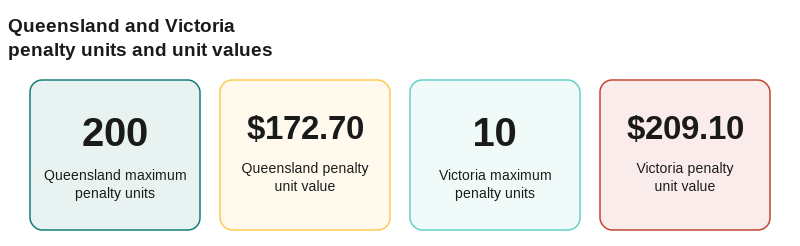
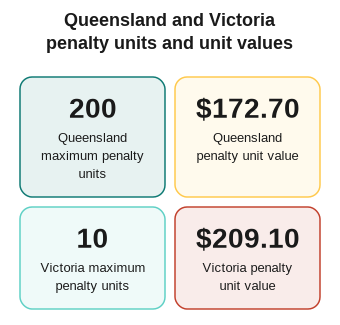
Source: Queensland Act s34, Queensland penalty unit, Victorian Act s36B, Victorian penalty unit.
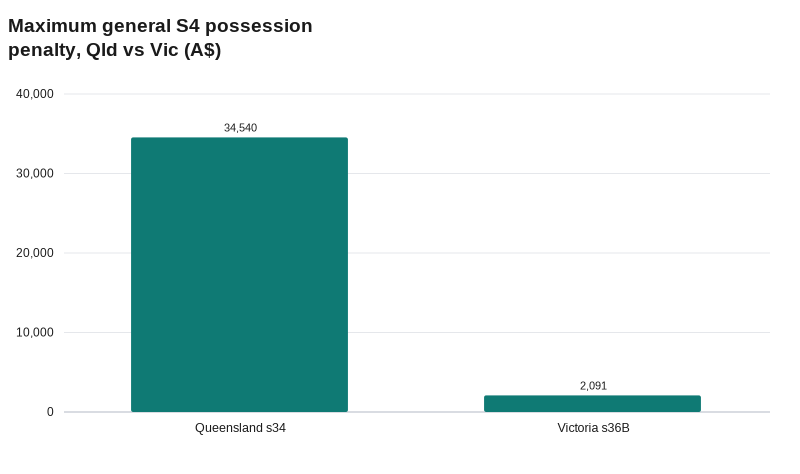
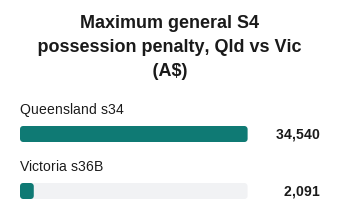
Source: our arithmetic from the penalty units and unit values in the Queensland Act and QLS Proctor ($172.70 x 200), and the Victorian Act and Victorian Department of Treasury and Finance ($209.10 x 10). These are each state’s general possession offence, not the same offence, and are maximums, not what a clinic would be fined.
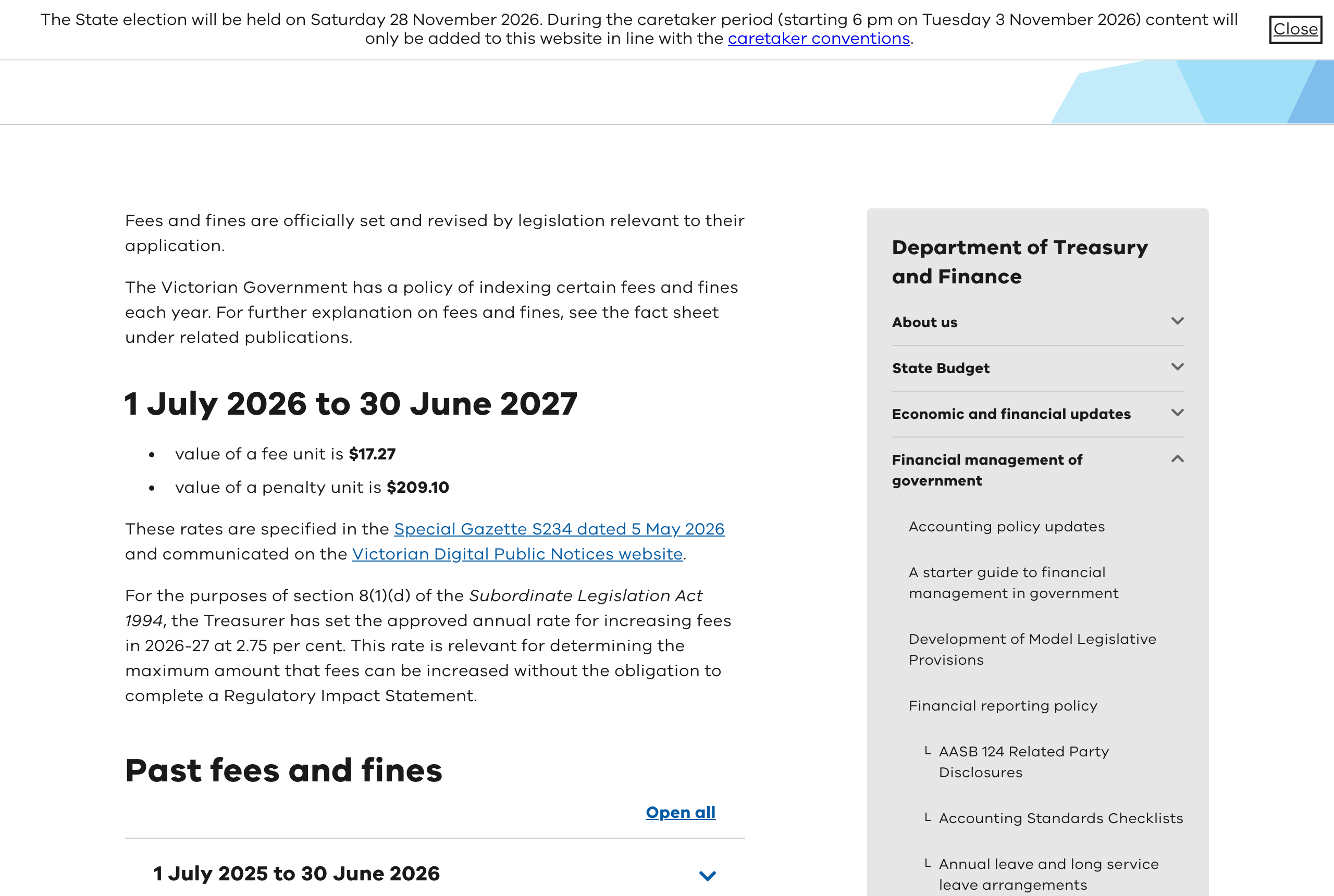
Takeaway: On the maximums above, Queensland’s ceiling is roughly 16 times Victoria’s (our arithmetic, $34,540 divided by $2,091). A published fact sheet is not the same thing as a changed law.
The Four Jurisdictions With No Cosmetic Guidance We Could Find
Western Australia, South Australia, the ACT and the Northern Territory each run their own medicines and poisons law, and we found no fact sheet or guideline from any of them that addresses cosmetic injectables specifically.
That does not mean these jurisdictions are unregulated. Where we could open a page, each requires a licence, permit or authorisation:
| State/Territory | Licensing mechanism | Source |
|---|---|---|
| Western Australia | Health Service permit, for purchase of medicines by health services | WA Health |
| South Australia | Licence to Sell, Supply, Possess or Administer a Schedule 4 or Schedule 8 Drug | ABLIS (SA) |
| ACT | Not confirmed by us | None |
| Northern Territory | Authorisation to Use or Possess S4, S7 or S8 Poisons | ABLIS (NT) |
We could not verify current penalty dollar figures for a Schedule 4 possession breach in any of these four jurisdictions, so we are not printing any. If your clinic operates in WA, SA, the ACT or the NT, ask your indemnity insurer or a health lawyer for the current figure rather than trusting a blog post, including this one.
On prescription validity, Dr Rudge’s article says 12 months applies in “Victoria, Queensland and other states” without listing them (University of Sydney). We found no source confirming a validity period for any of WA, SA, the ACT or the NT, so treat those as unconfirmed rather than assumed to match another state.
Takeaway: These jurisdictions run on general licensing regimes with no cosmetic-specific penalty we could find. That is not a loophole. It is a gap clinics are expected to fill with legal advice, not assumption.
What This Means for Clinic Owners
A website or booking flow that describes your clinic’s stock-holding model, prescription review cadence, or licensing status needs to match the state you actually operate in, not a template written for somewhere else. A clinic copying NSW’s 6-month review language into a Queensland site, or vice versa, is publishing something a regulator or a competitor’s complaint could flag. ClinicCode checks that kind of state-specific claim against the current rules before that happens.
The same logic applies to the stock-control side of the business. If your clinic’s model assumes a doctor holds exclusive custody in one state but your actual structure looks more like the remote-prescriber model Queensland Health’s fact sheet closed off, that is worth reviewing regardless of which state you are in, since nothing says another state will not reach the same interpretation next. ClinicCode builds Ahpra-compliant cosmetic clinic websites that describe licensing, stock control, and review cadence accurately for the jurisdiction the clinic is actually registered in.
ClinicCode’s compliance fix and build service for cosmetic clinics treats state variation as a permanent feature of this industry, not a one-off compliance project. Websites, ad copy, and booking flows get checked against the state’s current rules on an ongoing basis, not just at launch.
Takeaway: The compliance risk in this industry is not only in Ahpra’s national guidelines. It is also in the separate state laws, which differ on direction validity, stock custody and penalties.
The Bottom Line
No single national law governs how Schedule 4 cosmetic injectables are bought, held, or administered in Australia. Each state and territory runs its own law, and the details, prescription or direction validity, licensing, and penalties, do not line up. NSW’s new laws, which NSW Health says replace the old Act from 5 November 2026, limit written directions to 6 months. Queensland’s general possession maximum is 200 penalty units. Victoria’s is 10. We found no cosmetic-specific guidance from four jurisdictions.
ClinicCode builds websites and marketing for Australian cosmetic clinics that reflect the law as it actually applies in the clinic’s own state, not a generic version written for somewhere else.
Talk to us about a compliant clinic website or marketing system
Data sources: NSW Health, cosmetic use substances; Queensland Health fact sheet, 15 April 2025; Medicines and Poisons Act 2019 (Qld); QLS Proctor, penalty unit; Drugs, Poisons and Controlled Substances Act 1981 (Vic); Victorian Department of Treasury and Finance, indexation of fees and penalties; Victorian Department of Health fact sheet; Tasmanian Department of Health fact sheet; Ahpra media release, 3 June 2025; Medical Republic; WA Health; ABLIS SA; ABLIS NT; Dr Christopher Rudge, University of Sydney, republished from The Conversation (29 September 2025).
Related reading: for who is legally allowed to prescribe and administer cosmetic injectables by practitioner type, see Injectables by Nurses vs Doctors: Australia Data.
Vikas Thakur
Founder, Perth. 16 years of experience from working at TPG, iiNet and Monadelphous, now helping Australian clinics keep their websites, ads and online presence AHPRA compliant.